Event 1
Mal’akh’s Thirty-third-Degree Masonic Initiation
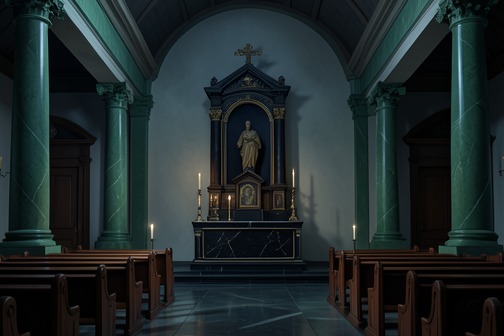
[Mal’akh’s Thirty-third-Degree Masonic Initiation](entity:event-recall-event-mal-akh-33-5a2039a915a7) is both a formal passage into the highest echelon of [Freemasonry](entity:organization-recall-organization-freemasonry-9faba02911a5) and a calculated act of deception. At the [Masonic House of the Temple](entity:location-recall-location-1b418e37a0c7), [Mal’akh](entity:character-recall-character-mal-akh-bd4f697ab5c9) takes part in a solemn ceremony of witnesses, vows, and symbolic transformation, but he enters the brotherhood not to honor its trust: he means to use his new standing as a route toward its most closely guarded secret. The scene makes initiation a threshold with two opposed meanings—belonging for the assembled brothers, and strategic access for the man they admit.
## Setting and Ritual
The ceremony takes place at 8:33 p.m. in the Temple Room of the Masonic House of the Temple, a Washington, D.C., building whose elaborate chambers and symbolic interior frame the rite as something set apart from ordinary life. The Temple Room is a vast square, with a high ceiling, green-granite columns, tiered walnut seating, a towering throne, and walls filled with varied ancient symbols. At its center stands a polished black-marble altar. Candles and moonlight give the gathering a deliberately ceremonial atmosphere; the room’s scale and ordered arrangement make the initiate the focus of a formal communal act.
The assembly consists of brothers in Masonic regalia, including lambskin aprons, sashes, white gloves, and ceremonial jewels. Their worldly status is set aside within the room: the ceremony presents them as equals bound by a shared fraternity. The candidate, by contrast, has already passed through earlier stages of the Masonic journey and now stands before the final step. The setting thus establishes both the appeal and the power of the institution: admission means entry into a community, but the community is structured around ranks and knowledge that are not equally available to all.
## The Passage to the Final Degree
The ceremony draws on the initiate’s earlier experience of entering Freemasonry. At his first degree, he had been blindfolded and asked to declare that he was freely and voluntarily seeking admission, without unworthy motives. He answered affirmatively, though he knew he was lying. The remembered oath becomes crucial context for the later ceremony: his advancement is not simply a change in rank but the continuation of an entry secured through concealed intent.
For the final stage, the initiate kneels and holds a human skull containing wine. The skull and the vow attached to the drink make mortality part of the ritual’s symbolism. Before he drinks, the assembled brothers wait in silence as he prepares to take the oath. The ceremony requires him to bind himself to secrecy through an invocation that the wine should become deadly if he knowingly breaks his promise. Rather than exposing his purpose, the solemnity of the vow gives his deception a convincing public form: he performs the act expected of a candidate while privately treating the moment as the beginning of a different undertaking.
## Mal’akh’s Hidden Purpose
The prologue withholds the initiate’s name, but later identifies the man as Mal’akh. Three weeks after attaining the thirty-third degree, he looks toward the luminous dome of the [United States Capitol](entity:location-recall-location-c17aa0c7a286) and thinks of an ancient secret hidden somewhere in Washington. His new rank has not revealed that knowledge to him. He understands that Masonic trust is granted through nested circles and that even a long wait might not win him the confidence of those who hold the deepest secret. The initiation has therefore served a purpose, but not the one its participants assume.
Mal’akh’s private response also reverses the ceremony’s apparent moral order. The brothers regard the oath as a binding commitment and the initiate’s admission as an act of trust. Mal’akh sees the initiation as a means to power, and anticipates that events set in motion by his admission will cost the presiding master what he holds dear. The ceremony does not itself disclose exactly how Mal’akh intends to obtain the hidden knowledge; it establishes instead that he has entered the brotherhood with a concealed agenda and does not expect its leaders to reveal their secret voluntarily.
## Significance in the Story
The initiation links the novel’s recurring concerns with secrecy, hierarchy, and transformation. In a classroom discussion, [Robert Langdon](entity:character-recall-character-robert-langdon-40771bb1ed5b) distinguishes a secret society from a society with secrets: Freemasonry is publicly visible, but its knowledge is protected through degrees, trust, and restricted disclosure. Mal’akh’s advancement dramatizes that distinction. He reaches the highest degree, yet rank alone does not grant him the information he seeks. His ceremony gives him proximity to the institution while leaving its central secret beyond his grasp.
The rite also creates an ironic contrast with Mal’akh’s later efforts to remake himself through bodily transformation. Here, change is conferred by a community through ritual and oath; for Mal’akh, the same passage is an instrument of private self-assertion. The scene’s solemn symbols and orderly witnesses cannot guarantee the sincerity they seem to certify. By placing a deceiver inside a brotherhood founded on guarded trust, the novel turns initiation into both a genuine threshold and a breach waiting to unfold.
Event 2
U.S. Capitol cornerstone-laying ceremony
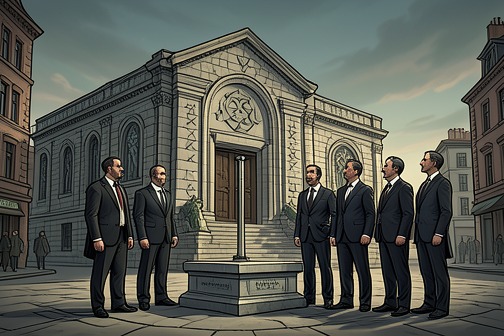
The [U.S. Capitol cornerstone-laying ceremony](entity:event-recall-event-6b1e70e9bec2) was a Masonic rite conducted by George Washington on [September 18, 1793](entity:time-recall-time-september-18-1793-d4a12cf05a37). In the novel, its timing and ritual form make the ceremony more than a construction milestone: it embodies the founders’ use of Masonic tradition and celestial symbolism in shaping the new capital, while later characters interpret it as part of a hidden history embedded in public architecture.
## Background and Participants
The ceremony took place within a city conceived and designed by Master Masons, including George Washington, [Benjamin Franklin](entity:character-recall-character-benjamin-franklin-6c959bf6686f), and Pierre L’Enfant. The novel describes these founders as shaping the capital through Masonic symbolism, architecture, and art. Washington, acting as the nation’s first president and a Mason, performed the cornerstone rite; a later mural depicts him in Masonic regalia at the work.
That history is set against competing ways of reading Washington’s design. Conspiracy theorists claim that the city’s streets conceal secret shapes and messages, but [Robert Langdon](entity:character-recall-character-robert-langdon-40771bb1ed5b) dismisses such map-based patterns as unreliable: draw enough intersecting lines, he argues, and shapes can be found in almost any city. He distinguishes that speculation from the more concrete historical evidence of Masonic participation in the founding and the ceremony itself.
## The Ceremony and Its Timing
The cornerstone was lowered with a tripod and pulley, a method Langdon identifies while teaching from a mural that portrays the event. He dates the ceremony to September 18, 1793, and gives its time as between 11:15 a.m. and 12:30 p.m. The detail matters because the moment was not presented as an arbitrary choice: Langdon explains that Washington, Franklin, and L’Enfant selected it in part because Caput Draconis was in Virgo.
The astrological alignment places the ceremony within a different conception of the heavens from modern popular astrology. In Langdon’s account, the founders treated the positions of the stars and fate as intertwined, and the date and hour of the Capitol’s founding stone reflected that belief. The ceremony therefore joined practical building work to a deliberately chosen celestial moment.
## A Repeated Celestial Pattern
Langdon broadens the significance of the Capitol ceremony by comparing it with the cornerstone-laying dates for the White House and the [Washington Monument](entity:location-recall-location-134577ee6422). Although the three structures were begun in different years, he says, their cornerstones were carefully timed to occur under the same astrological condition. The repeated alignment turns the Capitol rite from an isolated curiosity into one instance of a pattern across the principal buildings of the Federal Triangle.
In the novel, this pattern helps explain why Langdon describes Washington as unusually rich in astrological signs, including zodiacs, star charts, and foundations laid at precise celestial moments. His lecture presents these details as historical symbolism, not as proof that street maps encode a single all-encompassing conspiracy. The contrast is central to his method: the ceremony’s documented time and ritual offer specific evidence, while fanciful shapes found by drawing lines across a map do not.
## Later Meaning in the Novel
The ceremony becomes part of a larger argument about the capital’s public spaces and their layered histories. When Langdon later explains the [Capitol Rotunda](entity:location-recall-location-e692206b0aba) to [Inoue Sato](entity:character-recall-character-inoue-sato-6172b90919ce), he points to its classical and mystical references, including its design as a tribute to Rome’s Temple of Vesta and the former opening in the floor through which a flame in the crypt below could be seen. He also identifies the four-pointed star compass in the crypt as a reminder of that extinguished eternal flame. These details do not alter what happened at the cornerstone ceremony; they show how the novel places it within a capital whose civic buildings carry religious and esoteric imagery in plain sight.
The rite thus stands at the intersection of construction, civic identity, and Masonic tradition. Its lowering of a physical stone anchors the city’s material beginning, while its carefully selected hour gives that beginning a celestial frame. In Langdon’s reading, the ceremony exemplifies the novel’s recurring tension between visible monuments and histories that their everyday visitors may not recognize.
Event 3
Langdon Is Lured to Washington

[Langdon Is Lured to Washington](entity:event-recall-event-72bfca7e12fb) is the deception that turns [Robert Langdon](entity:character-recall-character-robert-langdon-40771bb1ed5b)’s ordinary Sunday into an involuntary journey to the [United States Capitol](entity:location-recall-location-c17aa0c7a286). A false request made in the name of [Peter Solomon](entity:character-recall-character-peter-solomon-26362346e09e)’s office, reinforced by a fax and carefully managed travel arrangements, brings Langdon from Boston to Washington for a lecture that does not exist. The invitation’s apparent familiarity—an old friend, a respected institution, and a subject Langdon already knows—makes the trap credible until an empty hall and a changed voice expose its central lie.
## An Ordinary Morning Interrupted
The episode begins far from Washington. At 4:45 on Sunday morning, Langdon swims his customary fifty laps at the Harvard pool. Later, at home, he starts his usual coffee ritual, grinding Sumatra beans. The red light on his voicemail interrupts this ordinary sequence: a caller introduces himself as Anthony Jelbart, Peter Solomon’s executive assistant, apologizes for the early hour, and says that Peter has been trying to reach Langdon urgently. The message provides a private phone number and presents the request as a matter requiring a prompt response.
The appeal works partly because of the relationship it invokes. Peter has been Langdon’s friend, mentor, and father figure since their meeting at Princeton University, where a lecture on semiotics and archetypal history helped awaken Langdon’s lasting interest in symbols. Peter’s reply to the young student’s thank-you letter began a close friendship; a call at daybreak from such a person therefore seems more likely to signal a genuine problem than a casual invitation. Langdon leaves his coffee unfinished and hurries to return the call.
A fax bearing Peter’s name and [Smithsonian Institution](entity:organization-recall-organization-337034b0fb2e) letterhead strengthens the appearance of authenticity. It asks Langdon to call the same number, and Langdon does so at his hand-carved oak desk. The message seems consistent with what he knows of Peter’s public responsibilities: Peter is head of the Smithsonian Institution, while his sister [Katherine Solomon](entity:character-recall-character-katherine-solomon-3fe9f5b28ace) is a leading figure in [Noetic Science](entity:concept-recall-concept-noetic-science-0de652de20a4). The fax does not provide an independent route to Peter, however. It sends Langdon back into the same channel through which the initial caller has already established contact.
## The Plausible Invitation
The supposed assistant explains that the Smithsonian’s annual private gala for its supporters will include a keynote address in [National Statuary Hall](entity:location-recall-location-270305ca5cad). The scheduled speaker has fallen ill, he says, and Peter wants Langdon to take her place. The proposed subject is a lecture Langdon previously gave on Bookspan TV about symbolism in the architecture of the nation’s capital, especially its Masonic history. The hall and topic appear to fit one another, while Langdon’s familiarity with the lecture makes the request seem possible even at short notice.
The timing is unusually urgent but is framed as a practical emergency rather than a warning sign. The event is that very evening. The caller says that a private jet can take Langdon from Boston to Washington and that he can return home before midnight. Langdon is asked to meet the plane at Boston’s Logan Airport at five o’clock. He recognizes that the arrangements leave little room to reconsider, but the appeal to Peter and the assurance that no new lecture preparation is needed persuade him to agree. The false request succeeds by assembling credible details around a single unverified claim: that Peter wants him there.
## The Empty Hall and the Exposure of the Lie
By the time Langdon reaches National Statuary Hall, the clock chime has faded and he is late for the supposed address. The room is recognizable from his earlier visit: a semicircular space with statues of thirty-eight Americans and a black-and-white marble floor. But there are no chairs, no assembled audience, and no Peter Solomon. A handful of tourists move through the hall, while tourists are also visible in the nearby Rotunda. The setting promised by the invitation is real; the event that was meant to explain Langdon’s presence in it is not.
Langdon asks a docent where the Smithsonian lecture is being held. The docent knows of no such event in the Capitol, at least not there, and asks when it is due to begin. Langdon answers that it should be starting now. He then calls Peter’s number, still assuming that the confusion may be a room change or some other mistake. The familiar voice answers as the office’s assistant, but instead of resolving the problem, it questions why Langdon trusted a fax and a telephone call from an unverified stranger, then boarded a private plane and entered a waiting car.
The exchange changes the meaning of every earlier detail. The caller admits that Peter has no idea Langdon is in Washington and says that Langdon is there because the caller wanted him there. The southern accent that had supported the assistant’s identity disappears, replaced by a different, deeper voice. The invitation is thus exposed not as an administrative mistake or a last-minute misunderstanding but as a deliberate summons. Langdon’s trust in Peter, which made the request persuasive, has been used to draw him into a situation whose purpose has not yet been disclosed.
## From Invitation to Covert Operation
The deception’s significance deepens as the larger crisis becomes visible. Later, on a CIA helicopter, [Inoue Sato](entity:character-recall-character-inoue-sato-6172b90919ce) shows Langdon footage from a tiny fiber-optic camera concealed in the bangs of a blond hairpiece. The recording depicts a Masonic initiation and, in later scenes, a gathering of influential figures that includes government officials and Sato herself. Langdon recognizes that the video has been edited to emphasize alarming moments while omitting the ritual’s broader context. Its selective presentation, he understands, could provoke public outrage and place the organization and Peter under intense scrutiny. This later discovery does not make the invitation’s original claims true; it reveals how far the events set in motion around Langdon reach beyond a nonexistent lecture.
The threat becomes immediate when [Mal’akh](entity:character-recall-character-mal-akh-bd4f697ab5c9) confronts Peter with the prospect of sending the initiation recording to major media networks. A file is already queued in an email program, and Mal’akh uses its progress toward transmission to pressure Peter for information about the Lost Word and the [Masonic Pyramid](entity:object-recall-object-masonic-pyramid-8b8bdfea92d8)’s final code. The later scene clarifies the stakes of the crisis surrounding Peter and the Masonic secrets, while the false invitation remains the mechanism that brought Langdon into Washington without Peter’s knowledge. Its importance lies in that reversal: the language of friendship, scholarship, and institutional duty conceals a purposeful act of deception, and the empty hall marks the point at which Langdon can no longer mistake the journey for a favor.
Event 4
Peter Solomon’s Abduction and the Hand of the Mysteries
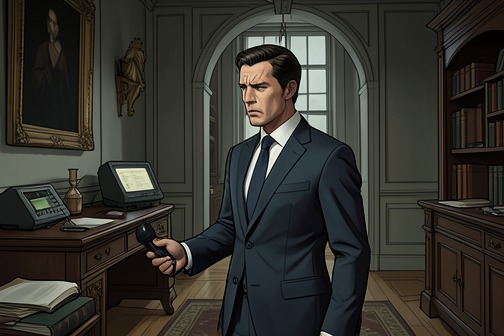
[Peter Solomon](entity:character-recall-character-peter-solomon-26362346e09e)’s abduction and the display of his hand in the [United States Capitol](entity:location-recall-location-c17aa0c7a286) transform a missing-person crisis into a cryptic summons. The hand is not merely evidence that Solomon has been seized: arranged as the ancient Hand of the Mysteries, it appears to invite [Robert Langdon](entity:character-recall-character-robert-langdon-40771bb1ed5b) into a search for hidden knowledge, while its markings begin to point toward a concealed place beneath the Capitol.
## The Call and the Stakes
In the [National Statuary Hall](entity:location-recall-location-270305ca5cad), Langdon receives a call from a man who says Solomon is his captive and that Langdon has been summoned for a reason. The caller speaks as though Solomon occupies a threshold between life and death, insisting that his fate could depend on Langdon’s actions. He connects the crisis to an ancient portal and knowledge supposedly entrusted to Langdon, though Langdon initially does not understand what the man means. The call therefore establishes the event’s central imbalance: Solomon is absent and vulnerable, while Langdon is being pressed to act without knowing either the captor’s identity or the full purpose of the demand.
The caller’s allusions lead Langdon to wonder whether the demand concerns ancient secrets, even the Holy Grail, but he denies knowing how to find the portal. The line goes dead before he can resolve the threat. Almost immediately, a scream from the [Capitol Rotunda](entity:location-recall-location-e692206b0aba) pulls him toward a second revelation. The narration moves from an unseen captive and an unidentified voice to a public scene in which an object left in plain view makes the danger unmistakable.
## The Hand in the Rotunda
A commotion has gathered around a hand standing upright on a small wooden base. At first, its posed fingers make it resemble an artist’s model; as Langdon approaches, however, he recognizes it as the right hand of his friend Peter Solomon from the familiar Masonic ring. The revelation abruptly changes the meaning of the scene. This is not an anonymous object or a prank, but a deliberate message built from a personal possession and a recognizable part of Solomon’s identity.
Langdon notices that the thumb and index finger bear small tattoos: a crown and a star. He recognizes the pairing as part of the Hand of the Mysteries, an old icon associated with a summons to receive protected wisdom. The remaining three fingers are closed, but Langdon knows that the traditional image bears five symbols, one on each fingertip. When officers examine the hidden fingertips, they find the other marks: a sun, a lantern, and a key. Together, the five symbols establish that the arrangement follows the icon rather than merely resembling a hand gesture.
The hand’s placement makes the sign public, but its meaning remains restricted. Langdon explains to [Inoue Sato](entity:character-recall-character-inoue-sato-6172b90919ce) and [Trent Anderson](entity:character-recall-character-trent-anderson-f796bbe71c04) that the icon historically functioned as an invitation to secret knowledge guarded by an elite few. He reads the display as a summons directed at him, recalling the caller’s claim that he had received an invitation. The message links the kidnapping to the search for the ancient portal, even as Langdon acknowledges that the situation seems impossible and the authorities remove him from the immediate scene.
## From Symbol to Investigation
The event also unfolds against the novel’s earlier discussion of [Freemasonry](entity:organization-recall-organization-freemasonry-9faba02911a5). In a lecture, Langdon distinguishes a society with secrets from a secret society: Masonic rings, buildings, and meeting notices are visible, while particular teachings are revealed through membership, trust, and hierarchy. He describes Freemasonry as a moral system expressed through allegory and symbols, not as a religion that promises salvation or seeks converts. Its members are required to believe in a higher power, but lodges prohibit religious discussion and do not prescribe a single name or theology for that power.
That explanation supplies a framework for reading Solomon’s hand without reducing it to proof of a conspiracy. The icon makes secrecy into a relationship: some knowledge is withheld, and the recipient must be recognized or summoned before gaining access. At the same time, the lecture acknowledges public suspicion and the limits of Langdon’s own certainty about the modern organization. The hand’s Masonic associations therefore intensify the mystery rather than settle who is responsible or what the hidden knowledge contains.
Later examination extends the message beyond the five familiar symbols. Investigators find seven additional small marks concealed beneath the clenched fingers. Langdon initially considers whether they combine different writing systems, but realizes that his first interpretations mix Roman, Arabic, and runic forms. He turns the wooden base upside down, applying the principle [As above, so below](entity:rule-recall-rule-as-above-so-below-946541aa8770); from that orientation, the markings can be read consistently as the Roman numeral XIII and the letters SBB. The hand thus changes from a ritual emblem into a coded clue, helping direct attention toward [SBB XIII](entity:location-recall-location-sbb-xiii-ad6cf5dea987) and an underground chamber.
## Consequences and Significance
The display does not resolve Solomon’s fate. Instead, evidence in the Rotunda suggests that he may still be alive: Langdon reasons from the condition of the hand that it was removed while Solomon lived. That recognition offers a narrow basis for hope, but it also makes the scene more urgent. Langdon is left to pursue the clues while Sato takes control of the investigation under the claim of national security, a priority Langdon does not yet understand.
The event’s force comes from the collision of recognizable personal evidence with a symbol that carries a much older, restricted meaning. The Masonic ring identifies Solomon; the crown, star, sun, lantern, and key turn the hand into the Hand of the Mysteries; and the less immediately legible marks provide a route into the next stage of the search. The sequence converts abduction into both threat and invitation, binding Langdon’s concern for his friend to a puzzle about secret knowledge and a hidden place beneath the Capitol.
Event 5
The Attack on Peter and Katherine’s Mother and Her Death
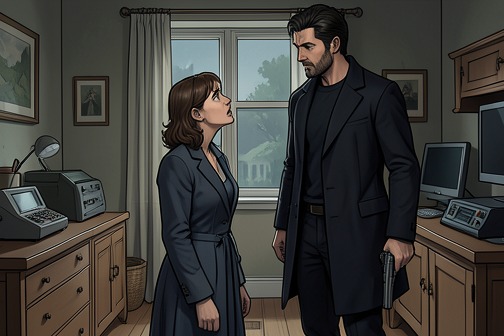
[The Attack on Peter and Katherine’s Mother and Her Death](entity:event-recall-event-127c8ce6325c) is the family tragedy [Peter Solomon](entity:character-recall-character-peter-solomon-26362346e09e) later connected to a choice he believed might have cost his mother her life. Recalled in a conversation between [Katherine Solomon](entity:character-recall-character-katherine-solomon-3fe9f5b28ace) and Peter’s therapist, the event is first presented as a robbery and a killing, then reframed through Peter’s guilt about what he had understood and withheld.
## The Attack Recalled
The attack took place on [Christmas Eve](entity:time-recall-time-christmas-eve-4c9949af68dd), almost exactly ten years before Peter’s account was discussed with Katherine. A man broke into the family home during a robbery attempt, looking for something he believed Peter was hiding. Peter shot the intruder dead. Their mother was murdered in the attack; Peter told his therapist that she died in his arms.
Katherine confirmed the broad outline when asked about the incident. She remembered that the intruder had made a specific demand, but said that none of the family had understood what he meant. For her, the request had remained an inexplicable part of a memory she had tried for ten years to block out.
## Peter’s Knowledge and Choice
Peter’s version changed the meaning of that demand. As relayed to Katherine by the therapist, Peter said he had known what the intruder was looking for. Rather than hand it over, he pretended not to understand. Katherine rejected this as impossible: the demand had made no sense to her, and she could not accept that her brother had understood it at the time.
Peter, however, believed his refusal might have altered the outcome. He wondered whether cooperating with the intruder could have kept their mother alive. The account does not establish that surrendering the sought-after object would have saved her; it establishes that Peter treated this possibility as the source of his guilt.
## The Delayed Disclosure
Katherine learned these details indirectly. Peter had disclosed the attack and his guilt to his therapist the previous day, during what the therapist described as an unexpected and dramatic opening-up. The therapist then recounted the account to Katherine while explaining his concern that Peter’s story might reflect a break with reality. Katherine resisted that interpretation and insisted that Peter was not delusional, even as the newly revealed claim about his knowledge unsettled her understanding of the family’s past.
The event therefore reaches the reader through two layers of recollection: Peter’s account to his therapist, and the therapist’s retelling to Katherine. Its central reversal is not the fact of the break-in, which Katherine already knew, but Peter’s claim that he understood the demand and chose not to comply. That late disclosure turns a remembered family loss into the focus of a private, unresolved counterfactual: whether a different choice could have prevented their mother’s death.
Event 6
Post-9/11 Anomaly in Random-Number Generators

The Post-9/11 Anomaly in Random-Number Generators is a reported scientific discovery in which outputs from machines around the world became less random during the hours after the [September 11, 2001](entity:time-recall-time-september-11-2001-f6eb4c28a3e6) attacks. In the account presented by [Noetic Science](entity:concept-recall-concept-noetic-science-0de652de20a4), the change suggested that millions of people focused in shared grief had affected physical systems, turning a moment of collective attention into evidence for consciousness acting beyond the individual mind.
## Discovery and Circumstances
Four scientists discovered the anomaly in the hours following the attacks. Thirty-seven Random Event Generators, distributed around the world, suddenly produced outputs that were significantly less random. The machines’ altered behavior was notable precisely because they were intended to generate random results: their outputs appeared to register a pattern amid the worldwide response to a single tragedy.
The account links the change to the frightened world’s shared focus on September 11. Millions of minds, gathered in grief around the same event, seemed to affect the generators’ randomizing function. The proposed connection was not that the machines represented human feeling, but that a collective mental state had changed what they physically produced.
## Interpretation in Noetic Science
The anomaly is presented as a major advance for Noetic Science because it appeared to connect collective human intention with measurable physical change. The generators’ outputs seemed to move from randomness toward order as attention coalesced around the attacks, giving concrete form to the idea that consciousness might interact with matter.
The event also appeared to echo the spiritual concept of cosmic consciousness: a vast joining of human intention capable of affecting the physical world. The account places the finding alongside later studies of mass meditation and prayer that produced similar results in Random Event Generators. Together, these findings support the claim that consciousness may function as an influence extending beyond the boundaries of an individual body.
## Narrative Significance
The anomaly marks a point where an immense public catastrophe and a technical measurement meet. The generators make an otherwise diffuse phenomenon—the shared attention of millions—legible as a change in machine output. In the argument developed around the event, the machines do not simply record an external world; their apparent departure from randomness suggests that human consciousness may participate in shaping it.
Its significance rests on that proposed connection rather than on a fully specified mechanism. The account treats the post-attack change as a striking parallel between collective grief and the ordering of physical systems, and as a foundation for the broader claim that focused human intention can influence matter.
Event 7
Peter Solomon Entrusts Robert Langdon with the Sealed Package
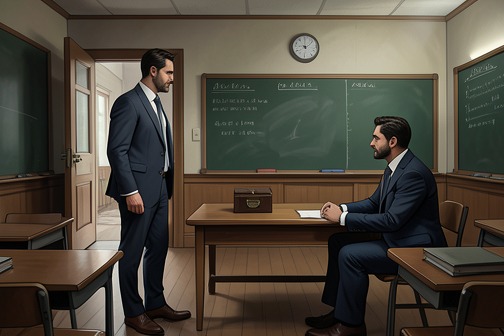
[Peter Solomon Entrusts Robert Langdon with the Sealed Package](entity:event-recall-event-c85fc44b7c8a) is the quiet handoff that sets the novel’s central chain of riddles in motion: Peter places a small, unopened inheritance in [Robert Langdon](entity:character-recall-character-robert-langdon-40771bb1ed5b)’s care, and Langdon’s promise to protect it eventually brings the key to the [Masonic Pyramid](entity:object-recall-object-masonic-pyramid-8b8bdfea92d8) into the unfolding crisis in Washington. The scene is remembered from years earlier, but its consequences arrive in the present when Peter asks for the package back.
## The Request and the Package
Peter visits Langdon before dawn at [Harvard University](entity:organization-recall-organization-cbbc668136d7), appearing unexpectedly in a deserted classroom. Their reunion is warm and teasing: Peter jokes about being on enemy territory as a Yale alumnus, while Langdon jokes about Peter’s age and recalls the trouble caused when he once looked after Peter’s enormous dog, Hercules. The banter establishes an easy friendship, but Peter has come on serious business and only has a few minutes.
He asks Langdon to look after something valuable that he inherited and no longer feels comfortable keeping at home or in his office. Langdon suggests a bank safe-deposit box, but Peter would rather avoid paperwork and bank employees. He wants a trusted friend, and specifically someone he knows can keep a secret. From his pocket he produces a package about three inches square, wrapped in faded brown paper and tied with twine. Its weight suggests stone or metal; a wax seal, carefully secured on one side, bears a double-headed [Phoenix](entity:creature-recall-creature-phoenix-1bf5db8bbe8f) and the number 33, a traditional emblem of the highest degree of [Freemasonry](entity:organization-recall-organization-freemasonry-9faba02911a5).
The package’s modest size contrasts with the history Peter attaches to it. The seal was not made by Peter: he explains that his great-grandfather wrapped the package almost a century earlier. The family’s Masonic ring, which bears the same emblem, had passed from great-grandfather to grandfather, father, and finally Peter. No one had opened the package. When Langdon asks why, Peter answers that it is not time. The sealed wrapping thus carries not just an object but an inherited delay: a family’s decision to preserve something whose purpose remains undisclosed.
## Trust Outside the Brotherhood
Peter asks Langdon not to open the package, to store it safely, and to tell no one that Peter gave it to him. Langdon wonders whether the elaborate secrecy is a playful attempt to make him curious about Freemasonry. Peter dismisses the idea: the Masons do not recruit, and Langdon has already said he would prefer not to join. Langdon respects Masonic philosophy and symbolism, but the order’s secrecy obligations would prevent him from discussing Freemasonry with his students. His refusal to become a member makes him useful to Peter in a different way: he is a trusted outsider.
Peter says that his own instinct is that the package will be safer outside the brotherhood. He also warns Langdon not to underestimate it: according to what his father told him, it contains something of substantial power, a kind of [Talisman](entity:concept-recall-concept-talisman-c6f9f9cca9ef). Langdon responds with academic skepticism, associating talismans with obsolete beliefs in luck, protection from evil spirits, and ritual magic. Peter does not ask him to accept the claim on faith. Instead, he acknowledges Langdon’s skepticism as both a scholarly strength and a limitation, and asks him simply to trust the warning.
Peter describes the supposed power as the ability to bring [Order from chaos](entity:expression-recall-expression-order-from-chaos-a4b6371348df), a central Masonic axiom. He insists that the object would be dangerous in the wrong hands and that he has reason to believe powerful people want to steal it. The exchange establishes the stakes without revealing what is inside: Peter knows more than he will say, while Langdon receives responsibility without explanation. The sealed package becomes an object of suspense precisely because the handoff withholds its contents and its intended moment of use.
## Safekeeping, Delay, and Recall
After Peter leaves, Langdon sits alone at his kitchen table with the package, trying to imagine what it contains. He ultimately attributes Peter’s warning to eccentricity, locks the parcel in the wall safe in his library, and forgets about it. The contrast between Peter’s grave insistence and Langdon’s eventual forgetfulness makes the later summons decisive: a request framed as an old favor turns an apparently dormant secret into an immediate obligation.
Years later, while arranging Langdon’s trip to Washington, Peter’s assistant remembers one more instruction. He reads Peter’s note asking Langdon to bring the small sealed package given to him many years before. Langdon recognizes the request at once and agrees. Before leaving home, he retrieves the parcel from the back of the safe and puts it in his shoulder bag. By the time he is inside the [United States Capitol](entity:location-recall-location-c17aa0c7a286), he believes he has failed Peter badly, though he does not yet know how the package’s presence will connect to the danger surrounding his friend.
That return also gives the original choice a new meaning. Langdon had accepted the package as a favor between friends, not as a participant in a secret society or as someone convinced of its alleged powers. But the very qualities that made him a suitable guardian—discretion, distance from the Masonic brotherhood, and a habit of examining symbols—make him central to what follows. The handoff has moved from a private act of safekeeping to a secret carried into the Capitol.
## The Package Becomes a Key
In the present-day investigation, Langdon keeps the package hidden even as the authorities question him about the seven symbols tattooed on Peter’s hand. When [Inoue Sato](entity:character-recall-character-inoue-sato-6172b90919ce) probes his sudden unease, he fears that her involvement may concern the object Peter warned could be stolen. Rather than disclose the package, Langdon improvises an explanation about the symbols to buy time. His secrecy is not abstract: it changes what he says during an active investigation and leaves him trying to protect both the object and his promise to Peter.
The tattoo becomes legible when Langdon turns the base supporting Peter’s hand upside down. From that angle, the marks can be read as the Roman numeral thirteen and the letters SBB, leading to the hidden chamber designation [SBB XIII](entity:location-recall-location-sbb-xiii-ad6cf5dea987). The episode echoes the earlier entrustment: Peter’s secrets are approached not by taking their first appearance at face value, but by preserving what is hidden and changing the angle from which it is read.
The package’s significance becomes clearer when [Warren Bellamy](entity:character-recall-character-warren-bellamy-981c3b4e368e) explains that the Masonic Pyramid is a map and that the [Gold Capstone](entity:object-recall-object-1cf853b2080d) is its legend, the key for reading it. Langdon deciphers the pyramid’s [Masonic cipher](entity:concept-recall-concept-masonic-cipher-5674d25956ca) using a grid-based substitution key, then works with [Katherine Solomon](entity:character-recall-character-katherine-solomon-3fe9f5b28ace) to recognize how the cipher’s four-by-four layout connects with the magic square in Albrecht Dürer’s [Melencolia I](entity:object-recall-object-i-cb895535c818). Later, [Mal’akh](entity:character-recall-character-mal-akh-bd4f697ab5c9) learns from Langdon’s desperate explanation that the pyramid’s base must be reorganized using an order-eight magic square associated with [Benjamin Franklin](entity:character-recall-character-benjamin-franklin-6c959bf6686f). The package Peter entrusted to Langdon is therefore not merely a valuable relic: its capstone helps make the pyramid’s coded directions readable and drives the pursuit of the lost wisdom. The old classroom promise—to keep an unopened package safe until its time—has become the practical condition for unlocking the mystery.
Event 8
Mal’akh Abducts Peter Solomon
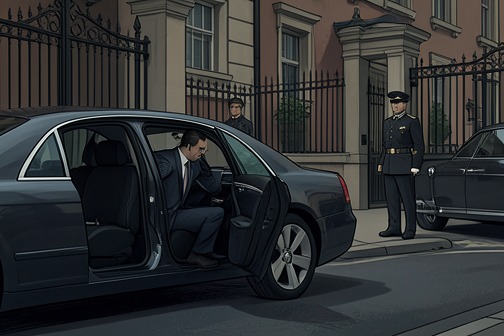
[Mal’akh Abducts Peter Solomon](entity:event-recall-event-a545f957ef8a) is the attack in which [Mal’akh](entity:character-recall-character-mal-akh-bd4f697ab5c9) turns a carefully staged private visit into [Peter Solomon](entity:character-recall-character-peter-solomon-26362346e09e)’s abduction. Entering as Dr. Christopher Abaddon, a supposed Masonic brother, he reaches Peter’s penthouse without raising suspicion, then reveals that the visit is driven by an old grievance and a demand for hidden knowledge. Peter is stunned, interrogated, gagged, and carried from his home.
## A visit built on disguise
The abduction begins with Mal’akh’s command of appearances. He arrives in a limousine dressed as a chauffeur, then changes in its darkened back compartment: he removes his cap, puts on a blond wig, straightens his jacket and tie, and checks that his makeup remains intact. The transformation allows him to pass from the role of hired driver to that of an invited guest. Earlier, he has entered Peter’s estate in [Potomac](entity:location-recall-location-485ff3cc1f7a); now he has come to Peter’s city residence, the guarded Dorchester Arms. His success in reaching Peter twice in two nights makes the breach feel deliberate rather than opportunistic.
At the building’s gate, Mal’akh presents himself as a chauffeur bringing Dr. Christopher Abaddon, whom Peter is expecting. The guard checks the guest log and identification, then admits the limousine. Once inside, Mal’akh finds no security cameras in the garage and parks in a dark corner near the elevators. He slips through the divider between the driver’s and passenger’s compartments, completes his change of identity, and takes the private elevator to the penthouse. Each ordinary safeguard—the invitation, the identification, the guest list—helps his deception succeed because it verifies the persona he has constructed rather than the person beneath it.
## Brotherly welcome, concealed history
Peter greets the apparent Dr. Abaddon in a private foyer and welcomes him into an elegant living room overlooking the Washington skyline. Their handshake brings [Peter Solomon’s Masonic ring](entity:object-recall-object-86e6834d71d3) into view: Mal’akh recognizes the hand that once aimed a gun at him. The gesture of greeting therefore carries a second meaning for the visitor, joining the present meeting to a violent past Peter does not initially recognize.
The two men share tea by the fire. When Mal’akh notices the tea, Peter explains that his parents greeted guests that way and that he has continued their tradition. Mal’akh requests it black; Peter calls him a purist and pours for them both. The courteous ritual gives Mal’akh time to maintain his cover and lets the meeting proceed as if it were an ordinary confidential conversation between Masonic brothers. Beneath that surface, however, Mal’akh has already decided that Peter is the man he hates most.
Mal’akh invokes the thirty-third degree, which Peter had helped confer on him a few months earlier. He thanks Peter for the honor, while inwardly recognizing that the degree has not disclosed the knowledge he seeks. Mal’akh had reached the thirty-second degree in his own lodge, then made a multimillion-dollar donation to charity in the name of the Masonic Grand Lodge; a month later, he received the invitation to the elite degree. He suspects Peter may have voted against him, but the initiation served another purpose: it gave Mal’akh power over the Masons through something that had happened in the Temple Room. His formal standing as a brother is thus both a credential for entering Peter’s home and part of a strategy that has already moved beyond the order’s rules.
## The confrontation and the demand
Mal’akh tells Peter that they met many years earlier. Peter does not remember him and apologizes, asking for a reminder. Mal’akh answers with the name Christopher Abaddon still as a mask, while privately acknowledging that it is not his real name. He then attacks. In one fluid motion he draws a small device and presses it into Peter’s chest; a blue flash and the stun gun’s discharge send a million volts through Peter’s body. Peter slumps in his chair, gasping and struggling to breathe.
Rather than immediately taking him away, Mal’akh watches Peter’s fear and lets him recover enough to speak. Peter asks why he has been attacked and guesses that Mal’akh wants money. Mal’akh rejects the suggestion: his multimillion-dollar gift to the Masons is evidence, in his view, that wealth is not what he lacks. What he wants is a secret Peter possesses, and he insists that Peter share it that night. Peter says he does not understand and denies knowing what Mal’akh means. Mal’akh treats the denial as a repetition of an earlier refusal, not as an answer.
He connects that refusal to the night Peter’s mother died, ten years before. Mal’akh says Peter used the same denial then and claims she need not have died if Peter had given him what he demanded. Peter’s expression changes as recognition breaks through his confusion. Mal’akh recalls warning Peter that he would haunt him if Peter pulled the trigger. Peter begins to respond, but Mal’akh drives the stun gun into his chest again. The second discharge leaves Peter limp, converting the recognition between them into the immediate physical dominance on which the abduction depends.
## Removal and unresolved threat
After the second attack, Mal’akh calmly finishes his tea, dabs his lips with a monogrammed linen napkin, and looks down at Peter. Although Peter’s body is motionless, his eyes remain wide and engaged. Mal’akh tells him he is taking him to a place where only truth remains, then stuffs the wadded napkin into Peter’s mouth. He hoists Peter’s limp body onto his broad shoulders and leaves by the private elevator, taking Peter’s iPhone and keys from the hall table on the way out.
The abduction leaves Peter in Mal’akh’s custody and establishes the immediate stakes of the larger search: Mal’akh believes the secret is in Peter’s possession and intends to force it from him. His final private demand reaches beyond information to an old wound, asking why Peter left him for dead. The scene therefore ends not with the secret disclosed, but with the past exposed enough to explain the violence and the captive’s danger still unresolved.
Event 9
Peter Solomon’s Severed Hand as a Clue
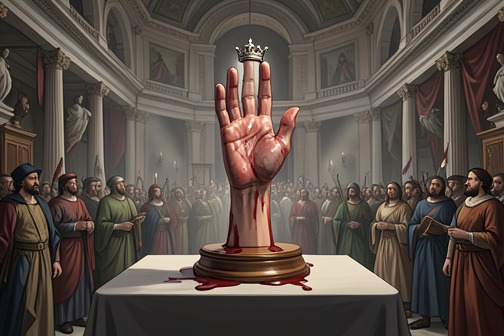
[Peter Solomon’s Severed Hand as a Clue](entity:event-recall-event-f9914182d9a6) is the moment an act of violence becomes both a summons and a code. Displayed in the [Capitol Rotunda](entity:location-recall-location-e692206b0aba), Peter’s hand leads [Robert Langdon](entity:character-recall-character-robert-langdon-40771bb1ed5b) from the symbolic Hand of the Mysteries to a set of concealed markings whose meaning changes when the hand is turned upside down. The clue draws the investigation toward [SBB XIII](entity:location-recall-location-sbb-xiii-ad6cf5dea987), below the [United States Capitol](entity:location-recall-location-c17aa0c7a286), while leaving the larger mystery of the ancient wisdom in play.
## Discovery and Invitation
The hand is set upright on a small wooden stand in the Capitol Rotunda, where Capitol Police are trying to clear the crowd. Langdon moves toward it through the confusion. He notices blood on the base and reasons that Peter may still be alive: the hand appears to have been removed while Peter was living. The inference makes the scene at once a sign of danger and a possible reason not to give up hope.
The hand’s extended thumb and index finger carry a crown and a star. Langdon recognizes the combination as part of the Hand of the Mysteries, an ancient icon traditionally represented in stone, wood, or drawings. Here, the symbol has been made from an actual human hand, turning a familiar emblem into something both unmistakable and deeply disturbing. The transformation matters to the investigation: the hand is not only evidence of a crime but a deliberately fashioned sign.
Langdon understands that the icon signifies an invitation. Across its history, the Hand of the Mysteries has served as a summons to an elite group believed to guard hidden wisdom, and its presentation implies that a master considers the recipient worthy of initiation. The connection reaches back to the invitation Langdon received before arriving at the Capitol. He concludes that Peter’s hand formally summons him to help unlock a portal associated with ancient knowledge, though the apparent purpose is so extraordinary that he remains unsure whether to trust his interpretation.
## The Hidden Markings
The first clue is not the only one. When Langdon later examines Peter’s open palm, seven small symbols become visible beneath the curled fingers. Their placement extends the hand’s message beyond the two marks that first identified the icon. Langdon initially struggles to classify them: some resemble numerals, but the apparent combination of Roman, Arabic, and runic forms does not make a coherent system. The uncertainty becomes part of the puzzle rather than a reason to accept the first reading.
Langdon explains that a code should be approached through a consistent symbolic system. His earlier mixture of possible Roman and Arabic readings may be a mistake, and the marks may look different from another angle. Under pressure, he uses this principle to buy time while [Inoue Sato](entity:character-recall-character-inoue-sato-6172b90919ce) questions him about the package Peter entrusted to him. He does not reveal the package; instead, he returns his attention to the symbols and searches for a single way to read them.
That approach also exposes the limits of his expertise. He can identify basic features of runic writing but cannot establish that the marks are runes, much less identify a particular runic alphabet. The first apparent Roman sequence does not work as written, and the remaining shapes do not settle the question. The clue therefore depends not on a confident first impression but on changing how the evidence is viewed.
## Reorientation and the Route Below
Langdon turns the wooden base upside down, so Peter’s extended fingers point downward. The symbols change meaning with the orientation: the sequence that had seemed invalid becomes the Roman numeral XIII, while the remaining letters can be read as SBB. The shift resolves the earlier conflict between systems without requiring the markings themselves to change. The hand that seemed to point toward the dome is, in fact, directing attention beneath the Capitol.
The abbreviation is immediately significant to [Trent Anderson](entity:character-recall-character-trent-anderson-f796bbe71c04), who recognizes SBB as a numbering system used in the Capitol Building. Inoue Sato presses him to open SBB XIII, overriding his concern about access procedures for private lower-level spaces and storage areas. Anderson requests a keyholder and a flashlight, and Sato makes clear that time is short. What began as Langdon’s interpretation of a strange tattoo has become a specific demand to enter a restricted location.
The descent deepens the clue’s effect on Langdon. As the party moves down through the building’s old foundations toward the Senate basement, his claustrophobia tightens, and he continues to hold in mind both the hand and Peter’s earlier warning that the Ancient Mysteries may be more than a myth. The markings have not yet explained what lies below, but they have converted an abstract summons into a route through a real building.
## Consequences and Significance
The clue joins several roles that might otherwise seem separate. The extended fingers make the hand an emblem; the hidden marks make it a coded message; and its placement in the Rotunda turns it into a public announcement of a private pursuit. Its meaning unfolds by stages, with Langdon first recognizing the invitation and only later discovering that orientation determines the practical direction of the message.
The episode also establishes a tension between what the hand appears to say and what it actually directs the characters to do. Its most visible gesture points upward, but turning it over reveals the downward route. That reversal gives the clue its force: reading is not merely identifying symbols but testing how their arrangement and viewpoint shape meaning. SBB XIII sends the investigation into a concealed part of the Capitol, bringing Langdon, Sato, and Anderson into the search for the hidden chamber and the deeper knowledge Peter’s captor is pursuing.
Event 10
Discovery of the Capitol’s Underground Reflection Room and Stone Pyramid
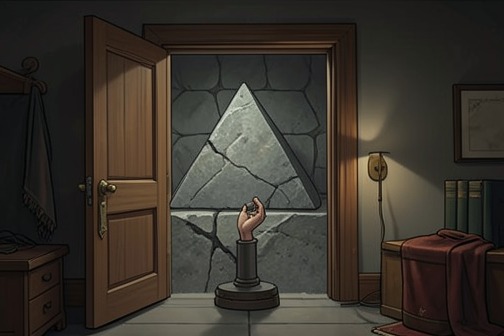
The [Discovery of the Capitol’s Underground Reflection Room and Stone Pyramid](entity:event-recall-event-2f9791f9e1e3) begins as an armed search for a location marked on [Peter Solomon’s severed hand](entity:object-recall-object-9466c34e1357) and ends with [Robert Langdon](entity:character-recall-character-robert-langdon-40771bb1ed5b) finding an object that alters the meaning of the mystery he has been drawn into. Behind an old door in the [United States Capitol](entity:location-recall-location-c17aa0c7a286), the search party uncovers a [Chamber of Reflection](entity:concept-recall-concept-chamber-of-reflection-d6fba3c5a858) and a small granite pyramid concealed inside its rear wall. The find offers physical proof that a Masonic chamber and pyramid are hidden beneath the Capitol, but it does not confirm the legend in the form Langdon expects: the stone is an [Unfinished Pyramid](entity:concept-recall-concept-unfinished-pyramid-076c0433411f), not the enormous, gold-tipped treasure of Masonic lore.
## The trail to [SBB XIII](entity:location-recall-location-sbb-xiii-ad6cf5dea987)
The discovery follows Langdon’s examination of the seven symbols tattooed on [Peter Solomon](entity:character-recall-character-peter-solomon-26362346e09e)’s palm. At first, the markings seem to mix systems: Roman numerals, Arabic numerals, and perhaps runes. Langdon’s initial readings do not produce a consistent explanation. He then turns the base supporting the hand upside down. Seen from that angle, the symbols form a more coherent sequence: XIII in Roman numerals and SBB in the Roman alphabet. The reversed perspective makes the marking a location clue rather than an assortment of unrelated characters.
That reading leads Langdon, [Inoue Sato](entity:character-recall-character-inoue-sato-6172b90919ce), and [Trent Anderson](entity:character-recall-character-trent-anderson-f796bbe71c04) down into the United States Capitol’s subbasement. The corridors are narrow and dark, and their small wooden storage rooms are arranged in a pattern Langdon compares to a mausoleum: seven facing seven, with one space removed for the stairs, leaving thirteen in all. The rooms appear abandoned. The first open room they inspect bears the label SBB IV; the final room, SBB XIII, is closed. Its copper number plate carries the same characters Langdon had just deciphered on Peter’s hand.
Sato insists that the door be opened, while Langdon objects that doing so may mean complying with Peter’s captor. The main key does not fit. When Anderson hesitates to shoot the lock, Sato takes his weapon and fires three times at close range. The damaged lock gives way, and the door swings open into darkness. The force of that entry marks a shift: the group is no longer interpreting a clue from a distance but physically crossing into the concealed space to which it points.
## Inside the Chamber of Reflection
The room initially resembles a bare, narrow cell, with a dirt floor and rugged stone walls. Its first revelation is a human skull at the far end, resting on a rickety desk alongside two leg bones and an arranged collection of objects: an antique hourglass, a crystal flask, a candle, two saucers of pale powder, and a sheet of paper. The tableau is disturbing, but Langdon identifies the room as a Chamber of Reflection, a Masonic setting intended for meditation on mortality. The skull, bones, hourglass, sulfur, salt, and candle are not simply macabre decoration; together, they make death and transformation the chamber’s governing ideas.
The room’s symbolism becomes legible through Langdon’s explanations. The skull represents the body’s final transformation through decay, while sulfur and salt function as alchemical catalysts and the hourglass gives time a transformative role. The candle stands for primordial fire and the awakening of the mind. These meanings complicate the party’s first impression of a death shrine: what seems designed to frighten is meant to prompt reflection on how to live in the knowledge that life is fleeting. The chamber’s constriction and its death-associated objects make the interpretation an immediate part of the scene rather than an abstract lecture.
A candle reveals a further clue on the rear wall: [VITRIOL](entity:rule-recall-rule-vitriol-ac90df0f5c30), a Masonic meditative formula whose meaning Langdon gives as visiting the earth’s interior and, through rectification, finding the hidden stone. The phrase can be understood in more than one tradition—as a reference to a concealed stone of power or enlightenment—but its placement makes the wall itself newly significant. When the surface appears to ripple, Langdon and Sato realize it is not a solid wall. It is a canvas banner that has billowed backward through an opening behind it. Langdon pulls it aside, exposing a roughly three-foot-square aperture in the brickwork.
## The hidden stone
The opening is only a few feet deep and ends in a niche, not a passage into a larger chamber. Set inside is a polished piece of solid granite about nine inches tall, with four smooth sides and a flat top. Sato asks Langdon to reconsider the possibility of a [Masonic Pyramid](entity:object-recall-object-masonic-pyramid-8b8bdfea92d8) hidden in Washington. He distinguishes the object from that legend: it is too small, lacks the legendary solid-gold tip, and is not even a complete pyramid in the strict sense. Its form is instead an Unfinished Pyramid, a familiar emblem on the one-dollar bill.
That distinction changes the find without diminishing it. The unfinished emblem signifies human potential as a work in progress, with the absent capstone representing an ascent not yet complete. Langdon connects it to the image printed on more than twenty billion bills and to the ideal of work still to be done by a country and by individuals. For the search party, however, the little stone is also a physical object concealed inside a chamber belonging to a Masonic leader, in precisely the underground setting indicated by Peter’s hand.
When Sato turns the stone, a fourth side becomes visible, bearing a [Masonic cipher](entity:concept-recall-concept-masonic-cipher-5674d25956ca). She takes this as evidence that Langdon may have been summoned because someone believes he can interpret what the pyramid contains. The distinction between the small Capitol artifact and the legendary pyramid therefore opens rather than closes the question: the object may be the key to information, even if it is not the monumental treasure people imagined. Later, [Warren Bellamy](entity:character-recall-character-warren-bellamy-981c3b4e368e) explains the relation differently: the pyramid is a map, and its golden capstone is its legend, the key to reading it. His explanation turns the object found in the niche into one part of a puzzle whose pieces have been kept apart.
## Consequences and significance
The sequence makes interpretation itself the event’s engine. The tattoo becomes a location only after Langdon changes its orientation; the apparent wall proves to be a hanging canvas; and the apparent legendary pyramid proves to be a familiar but incomplete symbol. Each reversal depends on looking again rather than accepting the first reading. Even the chamber’s disturbing arrangement shifts from apparent menace toward a structured meditation on mortality and transformation.
The discovery also moves the search from rumor into material evidence. Langdon had doubted accounts of a hidden pyramid and the Ancient Mysteries, but SBB XIII places an actual Masonic chamber, cipher, and stone object beneath the Capitol. The find does not prove every claim attached to the legend, and Langdon explicitly resists treating the small stone as the legendary Masonic Pyramid. Instead, it gives the characters a concrete next problem: decipher the inscription and establish what the object can reveal.
That problem leads beyond the chamber. Langdon and [Katherine Solomon](entity:character-recall-character-katherine-solomon-3fe9f5b28ace) later recognize that the pyramid’s first cipher points toward a magic square, and the final inscription requires an order-eight square associated with [Benjamin Franklin](entity:character-recall-character-benjamin-franklin-6c959bf6686f). The later decoding confirms the structural importance of Bellamy’s map-and-key explanation: the stone’s markings are not merely ornament, and the capstone is not interchangeable with the pyramid. The hidden room thus serves as both a destination and a threshold, revealing a carefully staged object while preserving the larger mystery it was built to unlock.
Event 11
Warren Bellamy Rescues Langdon
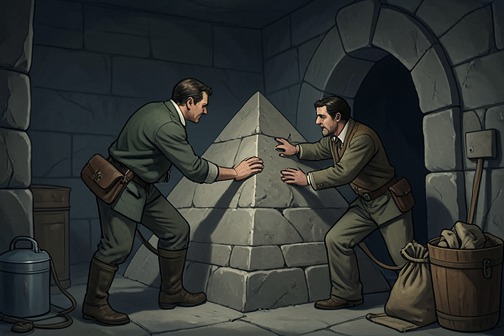
[Warren Bellamy Rescues Langdon](entity:event-recall-event-7833b5769766) is the turning point in which [Robert Langdon](entity:character-recall-character-robert-langdon-40771bb1ed5b)’s detention in the Capitol’s underground chamber gives way to a dangerous escape. Bellamy saves Langdon from [Inoue Sato](entity:character-recall-character-inoue-sato-6172b90919ce)’s custody and protects the stone pyramid and its capstone, making the rescue a contest over both a man’s freedom and the objects at the center of the night’s mystery.
## Intervention in the Chamber
Sato has decided to take Langdon to CIA headquarters, accusing him of lying to her and obstructing her investigation. While she directs [Trent Anderson](entity:character-recall-character-trent-anderson-f796bbe71c04) to pack the stone pyramid into Langdon’s bag, Anderson also places Langdon’s notes and the tiny package inside. The seizure threatens to put both Langdon and the objects beyond his control: Sato has photographed the pyramid’s engraving, and she expects CIA analysts to begin deciphering it. Langdon’s recognition that the small object is the pyramid’s capstone gives the packed artifacts a new importance, but he has no opportunity to explain before Sato takes charge.
A rush from the hallway breaks the confrontation open. The newcomer drives his shoulder into Anderson, sending him headfirst into the edge of a stone niche and onto the desk, where bones and artifacts scatter; an hourglass shatters and a lit candle falls. As Sato raises Anderson’s gun, the stranger strikes her shoulder with a femur, making her drop the weapon, then kicks it away. He turns to Langdon and orders him to take the pyramid and follow. The rescue is abrupt and physical: the chamber’s archaeological remains become instruments of interruption, and Sato’s attempted arrest collapses into disorder.
Langdon follows the stranger through the Capitol’s underground passages, carrying the heavy bag with the pyramid and capstone. Though he does not yet know the man’s identity or motive, he trusts him because he has intervened against Sato and acted to protect [Peter Solomon](entity:character-recall-character-peter-solomon-26362346e09e)’s pyramid. A glimpse of a Masonic ring bearing a double-headed phoenix and the number 33 offers the first clue to the stranger’s connection with Peter.
## Bellamy’s Identity and the Escape Route
The stranger led Langdon up an unfamiliar staircase and through corridors that made the Capitol seem less like a single building than a city beneath the city. A ring on the man’s hand, marked with a double-headed phoenix and the number 33, had already suggested a bond with Peter Solomon; now his command of the maze and the key ring that opened its doors showed that he possessed both influence and intimate knowledge of the building. The route passed through a service hallway cluttered with supplies and garbage, then into the [Capitol Visitor Center](entity:location-recall-location-5ca3885678bb), where the escape almost ended in an encounter with a Capitol police officer.
The officer, [Nuñez](entity:character-recall-character-nu-ez-18b3980cda17), was the same young guard who had screened Langdon earlier that night. Bellamy addressed him by name and ordered him to come along. At the visitor center’s southeast corner, Bellamy removed masking tape from heavy doors blocked with orange pylons and told Nuñez that Anderson might be injured in the subbasement. He then made the guard an accomplice: Nuñez was to lock the door behind them, replace the tape, keep the key, and tell no one—not even Anderson. Nuñez obeyed, despite his alarm, and Bellamy and Langdon passed through the concealed entrance.
Only after they were clear of the door did the rescuer identify himself as [Warren Bellamy](entity:character-recall-character-warren-bellamy-981c3b4e368e), the [Architect of the Capitol](entity:organization-recall-organization-6982d9974410) and a dear friend of Peter. His name made the earlier clues cohere: the authority with which he had directed Nuñez, his access to the keys, and the Masonic ring that linked him to Peter. Langdon told Bellamy that Peter was in terrible trouble and referred to his hand; Bellamy’s grim reply made clear that the mutilation was only part of what had happened. The rescue had secured Langdon and the pyramid, but it had not resolved the danger surrounding Peter.
Bellamy took Langdon farther into the Capitol through a modern corridor under construction. When the lit passage ended abruptly and the way ahead disappeared into darkness, Bellamy went into an electrical room and found the switch for heavy orange extension cords running into the unlit stretch. A series of construction bulbs came on, revealing a long, narrow unfinished tunnel. Langdon compared its function to the Vatican’s passetto, though this passage was modern rather than ancient; its intermittent lights made its distant end seem almost to vanish. The unfinished route was a practical escape passage and a fitting image of the night’s uncertain way forward: Bellamy could lead Langdon through it, but neither knew where events would take them next.
Nuñez’s choice to help did not remain hidden for long. Back in the basement police headquarters, Sato and Anderson reviewed surveillance recordings while a CIA field team prepared to pursue Langdon and Bellamy. Nuñez admitted to Anderson that he had seen the pair leave through the visitor center and handed over Bellamy’s key, describing it as the key to the new tunnel under Independence Avenue. When Sato joined them, Nuñez tried to protect Anderson by pretending the key had merely been found on the floor. The surveillance team had already located the relevant footage, however, and Sato identified Nuñez’s role and Bellamy’s gift of the key. She took it from Anderson and dismissed both officers from the matter, exposing how quickly Bellamy’s escape had turned a private act of loyalty into a breach visible to the authorities.
## The Escape’s Immediate Aftermath
Freedom from the Capitol did not give Langdon and Bellamy a secure refuge. At a desk in the [Main Reading Room](entity:location-recall-location-81db113e8888) of the [United States Library of Congress](entity:location-recall-location-de25dd987c2a), Langdon grew increasingly worried because Katherine had promised to call once she was safely out of her laboratory and on her way to meet him, but she had not called. Bellamy, meanwhile, had contacted someone he believed could offer them sanctuary; that person did not answer either, so Bellamy left an urgent message asking for a return call to Langdon’s phone.
With both expected lifelines absent, Bellamy acknowledged that they were on their own for the moment and turned the conversation to a plan for the pyramid. Langdon’s attention narrowed to the stone object and sealed package before him, displacing even the grand reading-room setting. The escape had preserved his freedom and kept the artifacts with him, but its immediate result was not safety: it left the two men waiting for help, with the pyramid’s purpose still unresolved and Katherine’s whereabouts uncertain.
## Significance and Limits of the Rescue
The escape changes the immediate balance of power without ending the crisis. Langdon is no longer in Sato’s custody, and the pyramid and capstone remain with him; yet Bellamy’s intervention brings the authorities’ attention onto the route they used, while Nuñez’s assistance is exposed and a CIA team prepares to pursue them. The rescue therefore exchanges one danger for another: freedom is recovered, but only as a precarious interval.
Its deeper significance lies in the way loyalty becomes action. Bellamy’s friendship with Peter is not merely disclosed through the Masonic ring and his introduction; it is enacted through his willingness to assault senior officers, enlist Nuñez, and guide Langdon through a concealed passage. The objects he protects remain inseparable from the effort to save Peter, while the tunnel carries the fugitives onward without promising a destination. By the time Bellamy and Langdon turn to planning around the pyramid, neither Katherine’s promised call nor Bellamy’s hoped-for refuge has arrived. The rescue preserves the possibility of continuing the search, but leaves its central human and interpretive problems unresolved.
Event 12
Zachary Solomon Is Killed in a Turkish Prison
[Zachary Solomon Is Killed in a Turkish Prison](entity:event-recall-event-0fd0c064fce2) is the loss that fractures the Solomon family and returns years later as a threat in the present. The account does not show Zachary’s death directly. Instead, it reconstructs the choices and failed efforts that preceded it, then lets a later intruder connect the prison killing to the family’s [Christmas](entity:time-recall-time-christmas-a573265d0167) gathering. What begins as a painful history becomes part of the danger facing [Peter Solomon](entity:character-recall-character-peter-solomon-26362346e09e), [Katherine Solomon](entity:character-recall-character-katherine-solomon-3fe9f5b28ace), and their mother, [Isabel Solomon](entity:character-recall-character-isabel-solomon-594aa1ec88ba).
## Family Background and the Inheritance
Zachary was Peter’s only son and Katherine’s nephew. As a teenager, he was described as frail, awkward, rebellious, and angry; he resisted the expectations of his privileged family, was expelled from prep school, and partied with the wealthy and famous. His parents tried to guide him firmly and lovingly, but the growing distance between Zachary and the family broke Peter’s heart. The recollection presents his later death against this earlier estrangement: the family’s grief follows a relationship that had already become difficult, but not one in which Peter had stopped trying to reach him.
Shortly before Zachary’s eighteenth birthday, Katherine sat with Peter and their mother as they debated whether he should receive his inheritance. The Solomon custom gave each child a substantial share of the family wealth on turning eighteen. The family regarded the money as most useful at the start of life, and its distribution to young descendants had also helped build the family’s fortune. Isabel worried that a large sum would be dangerous for her troubled grandson. Peter argued that the tradition should stand and that the responsibility might help Zachary mature. The decision became a painful point of contrast: Peter acted from confidence in the family custom, but the outcome did not match his hope.
## Estrangement and Imprisonment
After receiving the inheritance, Zachary left the family home without his belongings. Months later, he appeared in tabloid coverage of a wealthy young man living extravagantly in Europe. The reports of parties and drunkenness distressed the Solomons; news that he had been caught carrying cocaine across a border in Eastern Europe changed their concern into fear. He was held in [Soganlik Prison](entity:organization-recall-organization-soganlik-prison-27a9351bc75f), a harsh F-class detention center in the Kartal district outside Istanbul.
Peter flew to Turkey hoping to retrieve his son, but the prison authorities did not even allow him to visit. His influential contacts at the U.S. State Department were working to arrange Zachary’s extradition, offering the family a possibility of release without any assurance that it would happen in time. Two days after Peter returned without seeing his son, he received a devastating international phone call. The following morning, headlines reported that the Solomon heir had been killed in prison. The sequence is stark: Peter reaches the prison, is kept from Zachary, and leaves with extradition still pending; then the effort ends not in reunion but in news of Zachary’s death.
## Loss and Its Aftermath
The prison photographs were circulated by the media, which continued to air them even after the family had held a private burial. The public coverage prolonged the family’s exposure to the loss, while the burial marked an attempt to grieve privately. Peter’s wife never forgave him for failing to free Zachary. Their marriage ended six months later, and Peter was alone thereafter. The account does not present the marriage’s collapse as a separate dispute: it places the end of the relationship directly after the failed rescue and the death, showing how the event remained consequential well beyond the prison’s walls.
Years later, the family’s Christmas gatherings still carried the pain of Zachary’s death, although Katherine recognized that it was fading with time. Peter and Katherine were able to share a relaxed holiday conversation, and Katherine was glad to give her brother something hopeful to think about. The domestic scene—Isabel preparing the traditional feast while the siblings talked in the conservatory—shows a family attempting to resume ordinary closeness without erasing what happened. The loss has receded, but it has not disappeared.
## The Past Returns to the Present
That fragile holiday calm ends when a masked man enters the conservatory. He says that he knew Zachary in prison, claims responsibility for his death, and says Zachary told him where a key was hidden. These statements introduce the prison killing into the immediate Christmas-night danger, making the earlier account more than background to Peter’s grief. The man’s claim also supplies a link between Zachary’s time in Soganlik Prison and the later attack on the family, although this passage does not explain the key’s purpose or establish further details about the killing.
The event’s narrative force lies in this return. First, the family learns of Zachary’s death through a phone call and headlines; years later, a stranger brings the prison history into the family home and makes it part of a new crisis. The transition from public reporting to a direct claim at Christmas changes the meaning of the remembered loss: what seemed to belong to the past is revealed as connected to the threat confronting the survivors. The death therefore marks both a family bereavement and a turning point in the danger that gathers around the Solomons.
Event 13
Christmas-night attack on the Solomon home and Isabel’s death
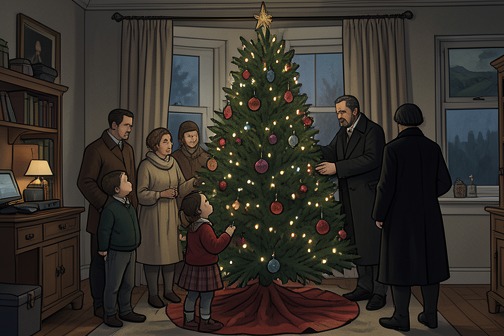
The [Christmas-night attack on the Solomon home and Isabel’s death](entity:event-recall-event-fbf4cd2fd925) transformed a family holiday into a violent confrontation over the [Masonic Pyramid](entity:object-recall-object-masonic-pyramid-8b8bdfea92d8). The intruder invoked [Zachary Solomon](entity:character-recall-character-zachary-solomon-d8ec2ec2095c), recently killed in a Turkish prison, to establish his connection to the family and demand the object; Isabel intervened when her children were threatened and died in the ensuing exchange. The event binds the family’s earlier bereavement to the danger that later returns with [Mal’akh](entity:character-recall-character-mal-akh-bd4f697ab5c9).
## Background and Stakes
Years before the attack, Zachary had received his inheritance and left the family. After he was caught carrying cocaine across a border in Eastern Europe, he was imprisoned at [Soganlik Prison near Istanbul](entity:location-recall-location-soganlik-6e5289d0e311). [Peter Solomon](entity:character-recall-character-peter-solomon-26362346e09e) traveled to Turkey hoping to bring him home, but was not permitted to visit him. Two days after Peter returned without Zachary, the family learned that Zachary had been murdered in prison. The news damaged Peter’s marriage, which ended six months later, and left the family living with a loss that only gradually became less acute.
By the [Christmas](entity:time-recall-time-christmas-a573265d0167) gathering years afterward, Peter, Katherine, and their mother, Isabel, could again share a family holiday. Isabel was preparing the traditional meal while Peter and Katherine talked in the conservatory. The intruder’s arrival abruptly broke that fragile calm. He said he had known Zachary in prison, claimed to have killed him, and displayed an old key he said Zachary had told him where to find. He had come not for money, but for what he called Zachary’s other birthright: the Masonic Pyramid, which he said Peter kept in his study vault. The claim made Zachary’s prison years and the family’s hidden inheritance intersect in a single demand.
## The Attack
Peter denied knowing what the intruder meant. The threat escalated when the man turned his weapon toward Katherine and used her safety to pressure Peter. Until then, Katherine had not known about the pyramid; confronted with the demand, she could only wonder what the intruder was referring to. Peter continued to deny the claim, while trying to persuade the armed man to take money instead and leave.
Isabel entered carrying Peter’s Browning Citori shotgun and confronted the intruder. Her intervention interrupted his threat against Katherine. She fired, and the intruder’s response sent gunfire through the conservatory before he crashed through the glass doorway, dropping his pistol. Peter seized the weapon and pursued him into the woods. Katherine, initially unable to identify the source of the blood on her, realized that Isabel had been struck. Isabel asked her to call an ambulance; when Katherine returned, she found her mother motionless and held her. A gunshot sounded from the woods before Peter came back into the conservatory. Seeing Katherine grieving beside their mother, he reacted with anguish. Katherine’s scream became the sound she would never forget.
## Loss and Family Consequences
The attack took Isabel from both her children while reviving the earlier catastrophe surrounding Zachary. At the beginning of the assault, Peter was already confronted with the name of the son he had failed to bring home; by its end, he and Katherine had lost their mother as well. The event therefore compounds rather than replaces the family’s grief: the intruder uses Zachary’s fate to reach the pyramid, and the resulting confrontation produces a further death inside the family home.
Katherine’s response is rendered through a moment of misrecognition. Seeing blood, she first believes she may have been hurt, then understands that it belongs to Isabel. The movement from shock to recognition makes her mother’s death the scene’s decisive turn. Isabel’s last clear action is to direct Katherine to seek help; Katherine returns to find her motionless, and Peter arrives only after the pursuit has taken him away from the room. The family’s holiday setting, made possible again after years of mourning Zachary, becomes the place where another loss is fixed in memory.
## Later Significance
The intruder is later identified as Mal’akh, who recalls having invaded the family home years earlier and having come close to taking the pyramid. Katherine’s knowledge of that history becomes significant when she later recognizes him as the person who attacked them. The Christmas assault was not an isolated attempt at theft: it was an earlier stage in Mal’akh’s continuing pursuit of the pyramid and in his conflict with the Solomon family.
The event also explains why the pyramid carries a personal history for Peter and Katherine beyond its role in the later mystery. The attacker’s account makes Zachary the link between the object and the prison, while Isabel’s death makes the demand for it inseparable from the family’s bereavement. The scene’s lasting consequence is not a resolution of the pyramid’s secret, but the return of an unresolved danger: Mal’akh escaped into the woods, and the attack’s connection to his later actions remained part of the threat facing Katherine.
Event 14
Mal’akh murders Trish Dunne
[Mal’akh murders Trish Dunne](entity:event-recall-event-af720fab2d33) in Pod 3, the Smithsonian’s specimen-storage area, to obtain the credentials needed to reach [Katherine Solomon](entity:character-recall-character-katherine-solomon-3fe9f5b28ace)’s secured research storage. The killing turns Trish’s ordinary access card into a tool of intrusion: her death both removes a partner from Katherine’s work and gives [Mal’akh](entity:character-recall-character-mal-akh-bd4f697ab5c9) a means to bypass her cooperation.
## Setting and Purpose
Mal’akh enters Pod 3 accompanying Trish, who is showing him the collections. The room holds preserved specimens, including a giant squid, Architeuthis, displayed in a large tank. As Trish describes the collection, Mal’akh pays little attention to the exhibits and instead checks the room for security cameras. He sees one trained on the entrance, an observation that helps him judge how much scrutiny he is likely to face.
His purpose is not simply to explore the facility. He anticipates that Katherine’s data-storage room may be difficult to access and expects that persuading her to open it could take time. Trish’s key card and its associated PIN offer an alternative. The murder is therefore part of Mal’akh’s effort to reach Katherine’s research: he identifies a practical obstacle, takes the credentials that can help overcome it, and intends to proceed without depending on Katherine’s willingness.
## The Confrontation
Trish senses that something is wrong and tries to end the visit, but Mal’akh seizes her and demands the PIN connected to her card. She initially challenges him and points out that security could see them, though she knows they are beyond the cameras’ range. When she fights back, she scratches his face, removing some of the makeup that conceals his tattoos. The brief revelation shows that the appearance he has presented to her is a disguise, but it does not give her a way to escape or summon help.
Under pressure, Trish gives him the number 0804 and explains that it is her birthday, August 4. Her answer supplies the information Mal’akh needs to use the card. The detail makes the credential more than a device number: it is a piece of personal information that Trish has turned into a security code, and Mal’akh converts that intimate fact into access. Once he has obtained it, he kills her in the specimen area. The account establishes the outcome without making the mechanics of her death the focus; the decisive action is the transformation of a workplace encounter into a means of forced entry.
## Concealment and Immediate Consequences
After Trish dies, Mal’akh places her body in the giant squid tank and closes it. He retrieves her card from the floor and keeps it, retaining both the physical credential and the PIN she has given him. The tank that had served as an exhibit becomes a hiding place, and the collection space is made to conceal the violence committed within it.
Mal’akh’s calculation changes as a result. He had first regarded Trish as a liability; once he realizes that her card and password can serve as his own set of keys, he no longer needs to spend time forcing Katherine to open the storage room. He also recognizes that the disguise has been damaged, but judges that it no longer matters: by the time Katherine understands what has happened, he expects to have moved ahead with his plan. The murder thus has a direct operational consequence, giving him access while reducing his dependence on the person whose research he seeks.
## Narrative Significance
Trish’s death is presented through a shift between Mal’akh’s instrumental attention and Trish’s growing alarm. He watches the room, its camera coverage, and the card he wants; she registers a danger she cannot initially identify and tries to leave. That contrast makes the scene’s central imbalance clear: Mal’akh treats people and access systems as parts of the same plan, while Trish’s attempts to resist cannot undo the advantage he has already created.
The scene also connects the killing to Mal’akh’s earlier violence. While disposing of Trish, he recalls [Isabel Solomon](entity:character-recall-character-isabel-solomon-594aa1ec88ba), whom he killed long before. The brief recollection places Trish’s murder within a repeated pattern rather than presenting it as an isolated act, and it links the Smithsonian episode to the Solomon family’s history of loss. For Katherine, the immediate consequence is especially intimate: her research partner is gone, and the credentials Mal’akh takes are intended to open the space that protects her work. Trish’s death therefore advances Mal’akh’s access plan while bringing its cost directly into Katherine’s professional and personal world.
Event 15
Katherine Solomon Escapes Mal’akh’s Attack in the Lab
[Katherine Solomon Escapes Mal’akh’s Attack in the Lab](entity:event-recall-event-58cacef30bed) is the sequence in which a warning about [Peter Solomon](entity:character-recall-character-peter-solomon-26362346e09e)’s abduction becomes an immediate threat to Katherine herself. Trapped in the darkness of Pod Five at the [Smithsonian Museum Support Center](entity:location-recall-location-f8605a56195a), she pieces together what has happened, evades an attacker, and escapes by exploiting the building’s enormous specimen bay and its motion-activated lights. Her flight ends with a revelation: the attacker is the man who killed her mother.
## Warning and Recognition of the Threat
[Robert Langdon](entity:character-recall-character-robert-langdon-40771bb1ed5b) tells Katherine that Peter has been taken captive and warns her that the message she received from Peter’s phone did not come from her brother. Katherine had believed Peter was on his way to the lab because a text said so; Langdon explains that the sender is dangerous and that the invitation to bring Dr. Abaddon inside is part of the deception. By then, Katherine’s assistant, [Trish Dunne](entity:character-recall-character-trish-dunne-e4e80d90b790), has gone to meet the guest.
Katherine calls the security guard and asks him to locate Trish on the surveillance recordings. The replay shows Trish escorting the guest through Wet Pod and using her key card to let him in. The guest emerges alone, while Trish is nowhere to be seen. The guard notices that the man’s sleeves are wet up to the elbows, and then sees him proceed toward Pod Five carrying what appears to be a key card. The footage converts Katherine’s suspicion into an urgent practical problem: the man is moving through the facility, and Trish has been left behind.
Katherine is already running through the dark corridor when the guard clarifies that he is watching recorded footage, not events as they unfold. The replay shows the guest entering Pod Five about ninety seconds earlier, using Trish’s key card. Katherine stops, understands that the intruder is inside the dark space with her, and asks the guard to send help and go to Wet Pod for Trish. She closes her phone to extinguish its light, leaving herself without a visible guide or a reliable sense of direction.
## A Pursuit in Pod Five
Katherine remains still and quiet as the intruder approaches. She detects him nearby, steps off the carpet, and tries to move away from its path. When the sound of her foot betrays her, he lunges and catches her lab coat. She slips out of it and runs, now unable to tell which way leads out. In the struggle that follows, she places her open phone on a waist-high metal strut; the attacker later pulls himself up beside the wall where she left it.
Feeling her way along Pod Five’s wall, Katherine uses the regularly spaced metal studs to keep moving. Their pattern breaks at a smooth panel. She realizes that it is the specimen bay, a giant movable wall designed to bring oversized specimens into and out of the pod. Nearby, the guard’s flashlight strikes the door as he tries to reach her, but he cannot get inside. The sound helps her orient herself, and the specimen bay offers another possible exit.
Katherine finds the bay’s handle, but the panel will not move. Searching its surface, she discovers a vertical security rod set into the floor. She lifts it out of its hole and tries the handle again. This time the immense panel shifts, admitting a narrow strip of moonlight. She widens the opening enough to squeeze through. The attacker reaches after her from inside, but she gets out and runs along the building’s exterior toward the main entrance.
## Turning the Facility Against Her Attacker
Katherine recognizes that she cannot reach the entrance or her Volvo before the pursuer catches up. Near the corner of Pod Five, she changes direction, runs out onto the lawn, and shuts her eyes as she crosses it. The motion-activated security lights blaze on. Because the attacker’s pupils have adjusted to the dark, the sudden brightness disrupts his pursuit; Katherine hears him falter while she continues across the grass with her eyes closed.
Once she is clear of the lights, Katherine opens her eyes, finds her way to her Volvo, and starts it. The headlights reveal the pursuer: a bald, bare-chested man whose skin is covered with tattoos, symbols, and text. He reaches the car and breaks through a side window, briefly restraining her as she tries to get away. The encounter has moved from an unseen danger in the laboratory to a direct confrontation in the vehicle’s headlights.
## The Identity of the Attacker and the Escape
The attacker tells Katherine that he killed her mother ten years earlier. His face, partly uncovered where his disguise has been torn, confirms what his words suggest. Katherine recognizes him as the man from the night her mother died. Until this moment, the pursuit has been a struggle to escape an unknown intruder; the recognition gives it a personal history and identifies the threat as [Mal’akh](entity:character-recall-character-mal-akh-bd4f697ab5c9).
Katherine throws the Volvo into reverse and accelerates, dragging the attacker alongside the car until the vehicle forces its way through the evergreens and into an upper parking lot. He gets to his feet and points at her, but she turns the wheel and drives off. She reaches Silver Hill Road, having escaped the facility and the man whose connection to her family has now been exposed. Trish’s whereabouts remain unresolved within this sequence: the guard has been asked to help her, but Katherine’s escape provides no confirmation of what happened in Wet Pod.
Event 16
Zachary Solomon’s Murder in Soganlik Prison
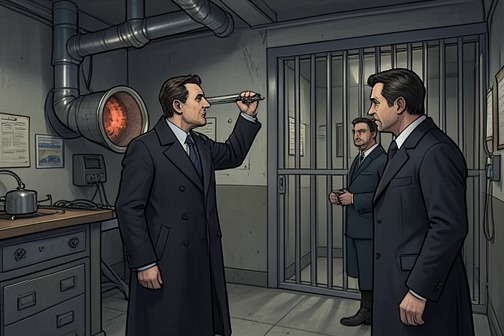
[Zachary Solomon’s Murder in Soganlik Prison](entity:event-recall-event-zachary-solomon-s-murde-d5ad68ef14bb) is both a family catastrophe and the origin of Inmate 37’s escape into a new identity. In a flashback framed by [Mal’akh](entity:character-recall-character-mal-akh-bd4f697ab5c9)’s recollection, the killing follows [Peter Solomon](entity:character-recall-character-peter-solomon-26362346e09e)’s refusal to secure his son’s release through a bribe. That decision, grounded in Peter’s insistence on accountability, leaves Zachary in prison and gives a fellow inmate an opening to turn the family’s fortune into a plan for freedom.
## The visit and the refused bargain
At the time of the events, the man who would later take the name Mal’akh is known only as Inmate 37. Held at [Soganlik Prison near Istanbul](entity:location-recall-location-soganlik-6e5289d0e311) on drug charges, he lies in his cell when a late-night conversation reaches him through a ventilation shaft. The visitor is Peter Solomon, asking whether his son is safe and being treated properly. The prison administrator answers evasively, then suggests that a payment could speed Zachary’s release, clear the charges, and spare him prosecution at home.
Peter refuses. He will not teach his son that money can erase consequences, particularly in a serious matter, and instead demands a chance to speak with him. The administrator denies that request unless Peter agrees to negotiate Zachary’s immediate release. Peter leaves without paying, warning that the State Department will be in contact and expecting his son to return home within a week. For Peter, refusing the bargain is a decision about principle and parental responsibility; for Inmate 37, overhearing it makes the limits of that principle—and Zachary’s separate wealth—part of a possible escape plan.
## A scheme built around Zachary’s fortune
Inmate 37 reasons that if money is what separates a prisoner from freedom, Zachary’s money could serve him better than Peter’s. He approaches the administrator privately the next day with a proposal: Zachary must die, but the two conspirators can disappear, and the administrator can retire to the Greek Islands. They reach an agreement. The murder is therefore not presented as a sudden prison altercation but as the intended price of a coordinated escape and financial theft.
The consequences reach the Solomon family two days later, when the State Department reports Zachary’s death. Records show that his large fortune had been moved into a private numbered account and emptied immediately afterward. The administrator is identified as the prime suspect and disappears. To the family, his flight with the money appears to explain both the killing and the loss of Zachary’s assets; the account of the event later reveals that Inmate 37 had helped arrange the scheme and was the one who gained a new life from it.
## Death, burial, and the escape
Peter travels to Turkey by private jet and returns with Zachary’s coffin. The family buries Zachary in the Solomon family cemetery, giving the death a formal and deeply personal aftermath even as the perpetrators evade justice. The administrator is never found. Inmate 37 knows he will not be, because the man is dead at the bottom of the Sea of Marmara. The narrative does not describe the killing in detail; it emphasizes instead the stark division between the family’s bereavement and the conspirators’ escape.
With Zachary dead and his fortune transferred to an untraceable account, Inmate 37 is free and immensely wealthy. Money buys him new identities, new passports, and the possibility of beginning again. He chooses the Greek name Andros Dareios, leaves the prison and drug world behind, and settles on [Syros Island](entity:location-recall-location-syros-132ce6fca763). There he enters a life shaped by wealth, leisure, reading, and strenuous physical training. His reinvention follows the prison ordeal: he vows never to return, and constructs a self radically different from the incarcerated man who had listened through the ventilation shaft.
## Significance and revelation
The flashback reverses the apparent meaning of Peter’s refusal. His choice is intended to uphold accountability rather than let money purchase an exemption, but the scheme exploits that choice and turns Zachary’s fortune into the means of his father’s loss. The event also changes the reader’s understanding of Inmate 37: he is not merely a prisoner who benefits from the administrator’s disappearance, but the planner who proposes Zachary’s death as the condition of their escape. The identity he later builds as Andros Dareios begins in that calculation, linking the family’s bereavement to the emergence of the man who will become Mal’akh.
Event 17
The Attack on the Solomon Estate and Isabel Solomon’s Murder
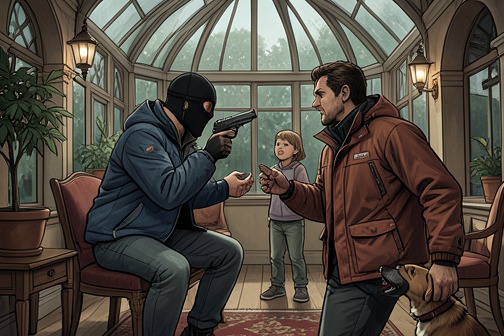
The attack on the Solomon estate links a failed attempt to take the family’s pyramid with a later [Christmas](entity:time-recall-time-christmas-a573265d0167)-day invasion that cost [Isabel Solomon](entity:character-recall-character-isabel-solomon-594aa1ec88ba) her life. Its first assault began when the intruder, then living as Andros and later known as [Mal’akh](entity:character-recall-character-mal-akh-bd4f697ab5c9), came to believe that the pyramid might offer the wisdom and power missing from his life.
## Background and First Assault
After leaving prison, Andros built a life on the Greek island of Syros, but material comfort and personal success did not relieve his persistent emptiness. A late-night television program about [Freemasonry](entity:organization-recall-organization-freemasonry-9faba02911a5) revived his memory of what [Zachary Solomon](entity:character-recall-character-zachary-solomon-d8ec2ec2095c) had heard from his father: a mysterious pyramid associated with lost wisdom. Andros concluded that the story might be true and that Zachary, though dead, had left him a route to the object.
Three weeks later, Andros went to the [Solomon estate in Potomac](entity:location-recall-location-5c303d001875). He saw [Peter Solomon](entity:character-recall-character-peter-solomon-26362346e09e) talking with his sister, [Katherine Solomon](entity:character-recall-character-katherine-solomon-3fe9f5b28ace), through the conservatory glass, then entered wearing a ski mask and carrying a handgun. He had come for the pyramid, but Peter’s household was not an unguarded route to it. Andros was driven out and fled across the grounds as Peter pursued him with a pistol.
The chase ended at a ravine, where the path stopped above an ice-covered river. With no bridge across, Andros turned back and faced Peter. Their confrontation shifted from the attempted theft to the death of Zachary: Peter accused Andros of killing his son, while Andros argued that Peter’s refusal to secure Zachary’s release from prison had made him responsible. Peter shot Andros, who fell toward the river. The immediate result appeared to be the end of the intruder’s threat, but Andros survived and escaped; the pyramid remained in the Solomons’ keeping.
## Survival and the Second Attack
Andros survived the fall by finding an opening in the ice near a fallen tree and forcing his way back to the surface. He concealed the hole, then reached a road in the snow and persuaded a passing driver to take him along, claiming that a hunter had shot him. The driver disappeared, and Andros later took his truck, discarded evidence of his escape, and learned from a radio report that the authorities believed the Solomon-estate murderer had fallen through the ice and been carried out to sea. The report also confirmed that Isabel Solomon had been murdered. Andros had failed to take the pyramid, and the family’s loss had not brought him closer to it.
His survival did not end his pursuit. Even after recovering and moving to New York, Andros remained fixated on the pyramid and the wisdom and power he believed it promised. On Christmas Day, six years after the first assault, an intruder claiming to have killed Zachary Solomon in prison broke into the Solomon estate. He had returned for the pyramid; he left without it, and Isabel was dead. The two attacks thus bookend a failed theft with a graver consequence: the object remained hidden, while the family paid for its concealment with another life.
## Aftermath and the Pyramid’s New Hiding Place
The attack changed how [Peter Solomon and Warren Bellamy](entity:relation-recall-relation-peter-solomon-and-wa-d743945cb6fc) protected the pyramid. Days after Isabel Solomon’s death, Peter summoned Bellamy and admitted that he should have followed his earlier advice. Bellamy brought the capstone, still wrapped in faded brown paper and tied with twine, its wax seal bearing Peter’s ring. The two pieces had been kept apart; now, in the wake of the invasion, they were brought closer together before Peter asked that the capstone be entrusted to someone else without telling him who.
Bellamy proposed hiding the pyramid in the [United States Capitol](entity:location-recall-location-c17aa0c7a286) Subbasement, which he considered the most secure place in Washington. Its location in the symbolic heart of the nation appealed to Peter, who approved the plan. The decision carried the consequences of the attack forward: the family’s loss led Peter and Bellamy to relocate the pyramid and renew its separate custody. A decade later, Bellamy understood that Peter had chosen [Robert Langdon](entity:character-recall-character-robert-langdon-40771bb1ed5b) to guard the capstone, and hoped Langdon would prove equal to the responsibility.
## Narrative Reversal and Significance
The estate attack is structured around a mistaken ending: after Peter shoots Andros at the ravine, the authorities presume the intruder has been swept away and killed, while the radio report pairs that belief with confirmation of Isabel Solomon’s murder. The later account of Andros’s escape overturns the apparent resolution, revealing that the man presumed lost survived and remained fixed on the pyramid. The Christmas-day invasion then gives that unresolved pursuit a second, more devastating consequence. Together, the attacks turn the pyramid’s concealment into an ongoing danger rather than a completed act of protection: Peter and [Warren Bellamy](entity:character-recall-character-warren-bellamy-981c3b4e368e)’s decision to move it to the United States Capitol Subbasement follows the family’s loss, while the object itself remains beyond the attacker’s grasp.
Event 18
The Destruction of Katherine Solomon’s Laboratory
[The Destruction of Katherine Solomon’s Laboratory](entity:event-recall-event-the-destruction-of-kath-d68fc971ef7b) is a calculated act of sabotage by [Mal’akh](entity:character-recall-character-mal-akh-bd4f697ab5c9), who sets off a hydrogen fireball at the [Smithsonian Museum Support Center](entity:location-recall-location-f8605a56195a) to prevent [Katherine Solomon](entity:character-recall-character-katherine-solomon-3fe9f5b28ace)’s scientific findings from becoming public. The attack devastates her laboratory, known as [The Cube](entity:location-recall-location-the-cube-75a835f8a570), and destroys the holographic storage units at its center. It also converts Katherine’s suspicion that her brother is in danger into a clearer understanding of the threat against her: the intruder is the same man who killed members of her family and has now turned against her research.
## Motive and Target
Mal’akh’s attack is directed not only at a building but at research he believes could alter human understanding. While moving through the laboratory, he recalls what he has learned about Katherine’s work: she is using modern science to investigate ancient questions about prayer, life after death, and the existence of the soul. He believes her experiments have produced persuasive, even conclusive, results, and fears that publishing them would change human consciousness. In his view, this knowledge would help people find their way, but it must not reach those he considers unworthy. Destroying the laboratory becomes the final task he intends to complete before his own transformation.
His immediate objective is to reach two holographic data-storage units in a secure data room. The contents of these compact devices, he recognizes, could affect human development, though he finds it difficult to reconcile that potential with their small size. The contrast makes the target especially pointed: the laboratory’s knowledge is held in fragile-looking equipment behind a formidable barrier, while Mal’akh is prepared to use the building’s own power infrastructure and combustible materials against it.
## The Sabotage
Mal’akh first tries to enter the data room with [Trish Dunne](entity:character-recall-character-trish-dunne-e4e80d90b790)’s key card, but the security panel does not respond. He then uses a second card taken from Katherine’s lab coat; this opens the door’s access panel, but he does not know Katherine’s personal identification number. Trish’s PIN fails. The data room’s door is three inches thick, and Mal’akh judges that even an axe would not let him break through to the storage units. With direct entry blocked, he turns to a planned alternative.
In the power-supply room, he finds the cylinders [Peter Solomon](entity:character-recall-character-peter-solomon-26362346e09e) had described, including reserve canisters of liquid hydrogen. He leaves one cylinder connected to the laboratory’s hydrogen fuel cell, moves a reserve cylinder on a dolly to the data-room door, and lays it on its side. A flexible tube fits beneath the door’s small gap. Mal’akh releases the cylinder’s contents into the room, where the cold liquid spreads across the floor around the pedestals holding the storage units. As it warms, it begins to boil into hydrogen gas, building a highly flammable atmosphere inside the sealed space.
He then brings over a Pyrex jug of Bunsen-burner fuel, an oil that is itself noncombustible but highly flammable. He applies it to the hydrogen cylinder and tubing and feeds some through the opening beneath the door. Backing away from the data room, he leaves a continuous line of oil across the laboratory floor. The plan turns a secure door into no protection at all: the gas gathers on one side while the fuel trail provides a route for ignition from elsewhere in the facility.
## The Fire and the Escape
At the same time, the attack is beginning to draw attention elsewhere in the complex. A perimeter patrolman receives word that the keypad to [SMSC Pod Five](entity:location-recall-location-smsc-aadfe7159f04) has been sabotaged and that a specimen-bay door stands open. When he investigates, Mal’akh pulls him inside and leaves him unable to stop the attack. The guard sees a can of Bunsen-burner fuel on the floor; Mal’akh ignites the oil trail and leaves through the open bay door. The flame runs toward The Cube, following the route prepared beneath the laboratory door.
The fire reaches the laboratory, and the hydrogen ignites. The ensuing fireball tears the roof from SMSC Pod Five and sends fragments of titanium mesh, electronic equipment, and melted silicon from the holographic storage units into the air. The destruction is therefore more than a breach of the facility’s security: it physically removes the data room and its contents from Katherine’s laboratory. Mal’akh has targeted the protected storage system because he cannot open it by ordinary means, then used the building’s layout and materials to destroy it from outside.
Katherine, meanwhile, is driving north after escaping the attack that brought her to the facility. From a pay phone at a gas station on Suitland Parkway, she has called emergency services. She asks for officers at the Smithsonian Museum Support Center to investigate the intruder and find Trish, and also asks them to check [Mal’akh’s Kalorama Heights mansion](entity:location-recall-location-mal-akh-kalorama-hei-92c1273fe5be), where she believes Peter may be held. She cannot reach [Robert Langdon](entity:character-recall-character-robert-langdon-40771bb1ed5b) directly, so she heads toward the [United States Library of Congress](entity:location-recall-location-de25dd987c2a), where he said he was going.
At first, Katherine sees the flash in her rearview mirror and tries to explain it as a distant display. When the light grows into an orange fireball rising above the trees, accompanied by smoke, she recognizes that the explosion is near the laboratory. Its appearance makes the attack’s consequence unavoidable: The Cube has been struck, and the work stored there is at risk. Her immediate response is shaped by several dangers at once—her brother’s captivity, the attack on the facility, and the possibility that the same intruder may still be pursuing her.
## Consequences and Significance
The laboratory’s destruction follows the revelation that Dr. Abaddon is not the ally Katherine had believed him to be. On the moving book conveyor beneath the city, she tells Langdon that the man who killed her mother and nephew has resurfaced, posed as Peter’s psychiatrist, and gained her trust by knowing intimate details about her family and research. She tells Langdon she is nearly certain that the man destroyed her laboratory that night. The attack thus joins the present danger to an older family wound: the intruder who once entered the Solomon home has returned under a false identity, and his violence now reaches Katherine’s work as well as her family.
For the plot, the explosion changes the status of Katherine’s research from guarded, ongoing investigation to knowledge under direct attack. Mal’akh’s motive makes the threatened research consequential beyond the physical laboratory: he fears that its findings, if disclosed, could shift human consciousness. The blast interrupts the possibility of a straightforward investigation at The Cube and sends Katherine toward Langdon while emergency services are directed to both the Smithsonian Museum Support Center and the mansion where Peter may be held. The laboratory’s destruction is at once a practical attempt to erase evidence and a collision between scientific inquiry and Mal’akh’s judgment about who should be allowed to possess knowledge.
Event 19
The Library of Congress Escape
[The Library of Congress Escape](entity:event-recall-event-the-library-of-congress-effc860f0950) turns a refuge into a trap and an overlooked piece of library machinery into a route to freedom. [Robert Langdon and Katherine Solomon](entity:relation-recall-relation-robert-langdon-and-k-b761feb685a9) flee the reading room with the [Masonic Pyramid](entity:object-recall-object-masonic-pyramid-8b8bdfea92d8) and its [Gold Capstone](entity:object-recall-object-1cf853b2080d), while [Warren Bellamy](entity:character-recall-character-warren-bellamy-981c3b4e368e) stays behind to draw their pursuers away. Their survival depends not on vanishing into the library’s famous shelves, but on using the concealed system that moves books between its buildings.
## Background and Stakes
The escape follows the destruction of Katherine’s laboratory. When she reaches the [United States Library of Congress](entity:location-recall-location-de25dd987c2a), Bellamy opens the massive bronze doors, and she rushes into Langdon’s arms. The reunion offers a brief pause in a night of fear: Katherine has lost years of research, and she knows the same man who destroyed her work also killed her mother and nephew. Langdon promises that they will find [Peter Solomon](entity:character-recall-character-peter-solomon-26362346e09e), but the crash from below interrupts her attempt to explain what has happened. Bellamy immediately urges them to leave.
In the illuminated [Main Reading Room](entity:location-recall-location-81db113e8888), Bellamy directs Langdon and Katherine to a reading desk, where his leather bag and the small cube-shaped package are waiting. When he places the stone pyramid alongside the package, Katherine recognizes the object as the pyramid that has so profoundly harmed her life, despite never having seen this engraved version before. Bellamy gives Langdon the bag and tells him to keep it safe. The object is not simply another piece of evidence: Peter had entrusted its protection to Langdon, and the Gold Capstone must remain with it. Protecting both pieces now competes with the urgent need to escape.
The [Central Intelligence Agency](entity:organization-recall-organization-f8fce2cfb9d5) team forces its way into the room using Key4, an explosive designed to open locked doors with limited collateral damage. [Turner Simkins](entity:character-recall-character-turner-simkins-d9587a60d61a) leads the operation. His team darkens the room, puts on night-vision goggles, and searches with weapons raised. The fugitive pair cannot wait for Bellamy to explain the route or the pyramid’s wider significance. The pursuit has reached the room, and the apparent exits are already under observation.
## The Reading Room and Bellamy’s Diversion
Bellamy takes Langdon and Katherine behind the central circulation desk, an octagonal structure surrounding a large wooden console. An opening in the console leads down a steep staircase to a small industrial-looking room beneath the reading room. The pursuers read the signs of recent passage: heat retained by chairs and a desk lamp, handprints on the counter, and fingerprints on a keypad. Thermal imaging turns the fugitives’ route into a trail, locating where they have been rather than merely where they are.
The agents follow the heat traces to the console and discover that the apparent cabinet is a raised ceiling over the stairs. Below, they find machinery and a heavy steel door. Simkins orders it breached, and the agents enter the underground stacks, where miles of shelves extend through the United States Library of Congress. At first, the maze looks like a promising hiding place. But the temperature-controlled environment makes heat signatures conspicuous, and motion-activated lights illuminate the fugitives’ path in a narrow, shifting strip. The building’s scale offers cover only until its systems begin to reveal movement.
That difficulty helps explain Bellamy’s decision to split from Langdon and Katherine. He opens a door into the stacks with his key card, gives the card to Langdon, and says that he will draw the agents away. His immediate concern is that the pyramid and capstone remain in safe hands; the escape plan is built around preserving those objects even if it costs him his own chance to leave unseen. He then directs Langdon and Katherine toward a different route, one that does not depend on outrunning the team through lit corridors of shelving.
## The Conveyor Route
Bellamy clears a large crate of books from a conveyor belt and tells the pair to lie on it, with their hands kept inside. The belt runs toward an opening in the wall, a space meant for transporting books rather than people. Langdon hesitates, but Katherine climbs aboard first, lying on her back with her hands crossed over her chest. With the agents already closing in upstairs, Langdon follows, placing his daybag on the belt and positioning himself at Katherine’s feet.
The route belongs to the building’s ordinary circulation system. Because the United States Library of Congress occupies three separate buildings, requested books can travel long distances on conveyors through underground tunnels. The machinery that makes the institution function as a library becomes their means of escape. Bellamy gives Langdon his key card and tells him to follow the conveyor to its end, get off before it circles back, and use the card to leave. Langdon has little opportunity to question where the route leads: Bellamy starts the machinery, and the moving belt carries him and Katherine into darkness.
The escape is not presented as a clean disappearance. As Langdon is carried away, he sees Bellamy race into the stacks and close the door behind him; moments later, a laser sight appears on the stairs. Aboveground, Simkins’s team uses thermal traces to follow the route from the reading room into the underground rooms and onward to the stacks. The conveyor gives Langdon and Katherine a head start by taking them beyond the obvious search area, while Bellamy remains behind to make the pursuers believe he is still the more immediate target.
## Consequences and Significance
The diversion works long enough for Langdon and Katherine to get away from the reading room, but Bellamy is soon found running through the illuminated stacks. Simkins’s team catches up and uses a nonlethal projectile that hardens into a web around Bellamy’s legs, bringing him down. Langdon is not with him. When the agents demand to know where Langdon has gone, Bellamy maintains his deception, claiming that he sent Langdon elsewhere and does not know his current location. His account sends agents away in pursuit of a false lead while the other agents take him into custody.
Before his capture, Bellamy has also managed to contact a man who can offer Langdon sanctuary and knows about the Masonic Pyramid and the hidden spiral staircase it is believed to indicate. Bellamy has left Langdon with the key card and instructed him to trust the person who will call. This knowledge makes the escape more than a flight from immediate danger: it carries the pyramid toward the next stage of the search, while separating Langdon and Katherine from the ally who has protected them.
The sequence sets two routes against one another. The agents use surveillance technology, heat, and light to make the library legible as a trail; Bellamy counters by exploiting an unremarkable service system whose purpose is to move books invisibly through the institution. Yet the price of the escape is clear. Langdon and Katherine leave the reading room with the Masonic Pyramid and Gold Capstone, but Bellamy is left behind, captured, and unable to accompany them. The library offers shelter only through movement, concealment, and sacrifice.
Event 20
Deciphering the Masonic Pyramid
[Deciphering the Masonic Pyramid](entity:event-recall-event-deciphering-the-masonic-20dbfcf50236) is the sequence in which [Robert Langdon and Katherine Solomon](entity:relation-recall-relation-robert-langdon-and-k-b761feb685a9) turn a sealed stone package, an engraved cipher, and a [Renaissance](entity:time-recall-time-renaissance-95b7e25b9862) artwork into a layered code. Its decisive result is [Jeova Sanctus Unus](entity:expression-recall-expression-jeova-sanctus-unus-19a7050d6a3f), a Latin phrase meaning one true God; its immediate complication is that this answer does not give [Mal’akh](entity:character-recall-character-mal-akh-bd4f697ab5c9) the location he wants. The puzzle therefore advances by discovery and frustration together: each solved layer offers a new way to read the objects, but not yet a plain route to [Peter Solomon](entity:character-recall-character-peter-solomon-26362346e09e).
## Causes and Stakes
Peter had entrusted Langdon with a cube-shaped package sealed with wax bearing Peter’s Masonic ring. Langdon understood that the package mattered to the stone pyramid: Peter had said it could help create order from chaos and warned that it must not fall into the wrong hands. [Warren Bellamy](entity:character-recall-character-warren-bellamy-981c3b4e368e) reinforced that warning, telling Langdon to conceal the pyramid and not open the package. He had explained the capstone as the key, or legend, to a map that might disclose the hiding place of ancient wisdom. The pyramid was thus presented as more than an inscription: it was an artifact whose parts had been separated and whose meaning depended on how they were reunited and read.
The warning collided with the purpose of the night’s pursuit. Langdon told Katherine that her brother’s captor had promised Peter would be returned alive if the pyramid were deciphered. Katherine, already grieving her nephew Zachary and her mother, refused to let the family’s remaining secret take precedence over Peter’s life. She reasoned that if the capstone was necessary to read the pyramid, opening it was the only available path to saving her brother. When Langdon hesitated because of Bellamy’s instruction, Katherine pulled the twine and broke the brittle wax seal. Her decision made the puzzle an immediate moral choice: preserving a guarded inheritance, or using it in an attempt to rescue Peter.
## The Sealed Package and Its Inscription
Inside the faded paper was a small gray stone box, polished like a granite cube and marked with no visible hinge or latch. Its apparent solidity concealed a hollow interior, as an X-ray had indicated. Katherine found a narrow slit along the top edge and carefully raised the lid. Within lay a gold capstone, still bright after more than a century enclosed in the stone box. Its small inscription seemed to promise a key, but its six words initially disappointed both investigators: [The secret hides within The Order](entity:expression-recall-expression-the-secret-hides-w-2554250a0df3).
The wording appeared at first to offer little beyond the premise they already knew. Langdon considered whether order referred simply to rearranging the pyramid’s letters, but that reading seemed too obvious. The capitalization of The Order suggested a reference to the Masonic Order, yet this, too, gave them no practical instruction. The capstone’s message was therefore both a clue and a refusal of easy interpretation: it pointed toward the Masons while leaving the method of reading the pyramid unresolved. Katherine’s question about the promised power to see order in chaos sharpened Langdon’s sense that he had not yet understood what the package was asking them to do.
A small marking on the gray box provided the next turn. Katherine noticed what looked like the date [1514](entity:time-recall-time-1514-294496734605) A.D. carved near one corner and proposed that it might point to a building or cornerstone from that year. Langdon recognized instead that the marking was a signature-like symbol: A.D. did not mean Anno Domini, or a date designation, but referred to a person. The person was Albrecht Dürer. The apparent date was not directing them toward a building completed in 1514; it was directing them to a particular work by the German artist, completed in that year.
## Dürer’s Work as a Reading Key
Langdon connected the box’s marking to Dürer’s [Melencolia I](entity:object-recall-object-i-cb895535c818), which he described as a work concerned with humanity’s struggle to comprehend the Ancient Mysteries. Katherine knew the engraving was held at the National Gallery of Art in Washington, but the gallery was closed. Rather than attempt to visit it, she used the library’s digital collections, searching the fine-prints catalog for Dürer. The screen displayed the work’s identifying details and a high-resolution image, allowing them to inspect its composition where they were.
The engraving gathers an array of objects around a brooding, winged figure: measuring scales, an hourglass, tools, geometric forms, a ladder, and other instruments of human thought and labor. Langdon read the figure as human genius surrounded by the resources of intellect yet unable to reach enlightenment. For the puzzle, however, the crucial object was not the central figure but a small numbered square carved into the building behind it, beneath a bell. Katherine located the square after Langdon directed her attention to the numbers. It contained 1514, linking the artwork back to the marking on the stone box and giving the apparent date a second, confirming role.
The square was a magic square, a mathematical arrangement in which rows, columns, and diagonals share a common total. Katherine checked several lines and found that each added to thirty-four. Langdon explained that Dürer had extended the pattern beyond the ordinary rows, columns, and diagonals: the four quadrants, the central four cells, and even the four corners also produced thirty-four. The placement of 15 and 14 together in the bottom row further associated the square with the year of the engraving. In the novel’s chain of clues, the numerical arrangement was not decorative background. It supplied a second grid that could be applied to the letters already obtained from the pyramid.
## Reordering the Pyramid’s Cipher
The pyramid’s initial inscription had been rendered through a Masonic substitution cipher. Langdon had explained that the method used four grids, two plain and two dotted, with letters assigned to distinctive enclosed shapes. Matching each engraved shape to the corresponding enclosure yielded letters, but the result was not yet an intelligible message. The capstone had supplied the instruction to seek order; Dürer’s four-by-four square now supplied a sequence for imposing it.
Langdon hesitated before proceeding, mindful that Peter had expressly urged him not to reveal the pyramid’s secret. Katherine insisted that she would decipher it herself if he would not. He then superimposed the numbered pattern from Dürer’s square on the pyramid’s letter grid, assigned a number to each letter according to its position, and built a new grid using the order specified by the magic square. The result initially looked like gibberish. On closer inspection, Langdon recognized that it was Latin, and Katherine read the phrase Jeova Sanctus Unus. She knew its sense as one true God, a Latin rendering associated with the Hebrew God’s many names.
The reading solved the arrangement of the letters without solving the practical problem. Katherine could not see how one true God would identify a location, and Langdon likewise recognized that the decrypted phrase did not answer Mal’akh’s demand for a place. Their disappointment exposed a distinction between decoding and understanding: they had followed a consistent method and obtained a meaningful phrase, but its meaning might be figurative rather than geographical. Langdon began to question whether the pyramid’s map should be understood literally, while Katherine objected that her family had guarded it for generations and that the authorities had treated the matter as a national-security concern. The correct reading, they suspected, was still incomplete.
## Significance and Continuing Uncertainty
The sequence binds physical objects to acts of interpretation. The sealed cube hides the capstone; the capstone refers to The Order; the marking on the cube points to Dürer; and the magic square supplies a rearrangement that makes the pyramid’s letters readable. None of these elements works alone. A date-like mark becomes a person’s initials, a detail within an artwork becomes a cipher key, and a grid of numbers becomes an ordering device. The puzzle’s progress depends on revising an initial reading whenever the next object changes the terms of the problem.
The first decipherment also preserves the danger of misreading. Langdon and Katherine produce a coherent Latin phrase, yet their result seems to fail the immediate test imposed by the kidnapping: it does not name a place where Peter can be found. The gap between a sound method and an apparently insufficient answer keeps the pyramid’s promise unresolved. What they have established is that its message is structured, that its parts were meant to be read together, and that apparent disorder can conceal a deliberate arrangement. What the phrase ultimately points toward remains unsettled at this stage.
Event 21
Warren Bellamy’s Capture and Interrogation
[Warren Bellamy’s Capture and Interrogation](entity:event-recall-event-warren-bellamy-s-captur-387c752c5405) turns Bellamy’s effort to protect [Robert Langdon](entity:character-recall-character-robert-langdon-40771bb1ed5b) and the [Masonic Pyramid](entity:object-recall-object-masonic-pyramid-8b8bdfea92d8) into a contest over what must remain secret, who can be trusted, and what counts as a threat to national security. Bellamy is caught by the pursuing team in the Library of Congress stacks after helping Langdon escape with the pyramid and [Solid-Gold Capstone](entity:object-recall-object-9c7ac3585f4c). His captors then take him to [The Jungle](entity:location-recall-location-the-jungle-c8dcfdce5fc2), where [Inoue Sato](entity:character-recall-character-inoue-sato-6172b90919ce) questions him, lays out how she has pieced together the night’s events, and demands that he help bring Langdon and the objects into her custody.
## Capture in the Library of Congress
[Turner Simkins](entity:character-recall-character-turner-simkins-d9587a60d61a) and his team pursue the fleeing men through temperature-controlled stacks. The team’s thermal goggles reveal traces left on a banister, but the library’s motion-activated lights soon make the chase visible without them: each section of the fugitives’ route lights ahead like a trail. Simkins’s team follows it through the rows of books and closes on Bellamy, who is bringing up the rear. When repeated commands to stop have no effect, an agent fires a nonlethal restraint projectile. It hardens around Bellamy’s legs, bringing his flight to an end.
The capture changes the team’s understanding of the chase. The stacks ahead of Bellamy are dark; there is no other runner for the agents to pursue. Bellamy has been left alone, and the team has not caught Langdon. Simkins directs the others to continue searching while Bellamy is questioned. His captors demand to know where Langdon is. Bellamy answers with a deliberate lie: he claims he sent Langdon toward the balcony to hide behind the Moses statue, though he says he does not know where Langdon went afterward. The deception sends two agents away in pursuit and buys Langdon time.
Bellamy is bound and blindfolded, then marched through the stacks. The familiar ritual hoodwink of his Masonic initiation provides a pointed contrast: that blindfold had been worn among trusted brothers as part of a voluntary ascent through the degrees, whereas this one marks his capture and isolation. His confidence rests on a different fact: Langdon and [Katherine Solomon](entity:character-recall-character-katherine-solomon-3fe9f5b28ace) are carrying the pyramid and capstone toward safety, and Bellamy has arranged for Langdon to seek sanctuary with someone who understands the objects’ secret.
## Taken to The Jungle
The agents transport Bellamy in an SUV, stopping after a short drive and gaining entry to a nearby complex by invoking a CIA investigation and national security. Still blindfolded, Bellamy is led through secured doors and corridors into a warm, humid environment. He recognizes the destination only when its distinctive atmosphere gives it away: The Jungle, the greenhouse centerpiece of the [U.S. Botanic Garden](entity:location-recall-location-7a0c80c28caa), close to the Capitol complex.
The place is familiar to Bellamy. He runs it, and his own key fob has helped the agents gain access. That reversal makes the greenhouse’s usual comfort feel different: a place associated with his work and with living growth has become the site of his confinement. His captors secure him to a bench and leave him alone, blindfolded. Inoue Sato then appears, removes the blindfold, and begins the interrogation.
## Sato’s account of the night
Sato challenges Bellamy’s version of events and describes what she knows: he received a call while dining outside the city from a man who said he had kidnapped [Peter Solomon](entity:character-recall-character-peter-solomon-26362346e09e), sent Langdon to the Capitol with a task to complete, and threatened Peter’s life if Langdon failed. Bellamy had tried Peter’s numbers and, unable to reach him, hurried to the Capitol. Sato also knows that Bellamy later sent the kidnapper a text message saying that he and Langdon had obtained the Masonic Pyramid and would cooperate. In reality, Bellamy had meant the message to buy time and conceal the objects’ whereabouts.
Sato explains that the agents took Bellamy’s phone and that the [USA PATRIOT Act wiretap authority](entity:rule-recall-rule-usa-patriot-act-wiretap-345832266b5b) gave her a way to monitor Peter’s calls. She says she had tapped Peter’s phone, which allowed her to hear Bellamy’s anxious message and the earlier call in which the kidnapper, posing as Peter’s assistant, persuaded Langdon to come to Washington with a package Peter had entrusted to him. That intercepted call prompted Sato to have Langdon’s bag examined by X-ray. The discoveries help explain why she arrived at the Capitol and why she knew to focus on Langdon’s belongings; they also show that she had assembled much of the night’s sequence without Bellamy’s cooperation.
## Secrets, loyalties, and leverage
Bellamy suspects Sato is working against him and asks whether she intends to take the pyramid. She rejects that assumption. She says she, too, understands the need to keep certain information from the public, but argues that the kidnapper poses a danger far beyond the objects themselves. In her view, he is capable of setting off events that could profoundly change the world. Bellamy counters that his Masonic vows prevent him from revealing the location of the hidden spiral staircase associated with the Ancient Mysteries.
Sato asks Bellamy to call Langdon and tell him to surrender with the pyramid and capstone. Her plan, as she presents it, is to take Langdon into custody, have him decipher the pyramid’s inscription, and obtain the information the kidnapper wants. Bellamy refuses. His resistance makes the central conflict more than a disagreement about tactics: Sato invokes national security and an impending catastrophe, while Bellamy holds to obligations that prohibit him from handing over the secret.
Sato’s interrogation also clarifies the limits of her intelligence. She says the trace on Peter’s cell phone went dead before it revealed a location, and that another number appeared to be disposable. The private-jet booking, she tells Bellamy, had been made by Peter’s assistant using Peter’s phone and jet card, leaving no useful trail. Even finding the kidnapper would not necessarily make an intervention possible; Sato refuses to explain why, describing that information as classified. Her claims leave Bellamy with a picture of a crisis that she insists he cannot yet understand, but they do not resolve his distrust.
## The widening pursuit
While Bellamy is being held, Sato receives updates about Langdon and Katherine. When one report places them in a taxi, she orders the field team to bring them to the U.S. Botanic Garden through the service entrance and to recover the pyramid and capstone. She then tells Bellamy that he has outlived his usefulness. Later, as the search continues and Sato grows more urgent, she asks him once more whether he knows where Langdon has gone. Bellamy does know, but denies it and will not betray the refuge.
Sato confronts him with the details of his earlier movements, including his flight from the Capitol and his text to the kidnapper. Bellamy is startled by the extent of her knowledge. When he questions how she obtained it, she again identifies the wiretap as her source and insists that Peter, Bellamy, and the Masons’ concealed knowledge all fall within her security concerns. Her attempt to recast them as allies does not persuade Bellamy: the restraints and her demands remain tangible, while her most consequential explanation for why she cannot simply move against the kidnapper remains withheld.
The exchange ends with Sato bringing in a titanium briefcase. She opens it, dismisses the agent who carried it, and tells Bellamy that what it contains will persuade him to see matters her way. The contents are not disclosed in this part of the confrontation. The unresolved threat of the case leaves the interrogation at a point of suspended leverage: Bellamy has protected Langdon’s escape through silence and misdirection, while Sato has exposed how much she knows and prepares a new means of pressure.
Event 22
Langdon and Katherine’s Escape to Washington National Cathedral

[Langdon and Katherine’s Escape to Washington National Cathedral](entity:event-recall-event-langdon-and-katherine-s-510f83732bcb) turns a flight from the Library of Congress into a contest over who can read the clues—and the city—more accurately. [Robert Langdon and Katherine Solomon](entity:relation-recall-relation-robert-langdon-and-k-b761feb685a9) evade a [Central Intelligence Agency](entity:organization-recall-organization-f8fce2cfb9d5) pursuit by making [Freedom Plaza](entity:location-recall-location-freedom-plaza-9a30a3da5235) and its Great Seal part of a deliberate false trail, then reach the cathedral whose physical details answer the cryptic promise of sanctuary. The escape carries them from an exposed street chase to a refuge, while preserving the stone pyramid they believe may lead them to [Peter Solomon](entity:character-recall-character-peter-solomon-26362346e09e).
## Flight from the [Adams Building](entity:location-recall-location-7445c68d4163)
Robert Langdon and Katherine Solomon emerge through a side door of the Adams Building into a dark, cold winter night. They have spent hours inside the Library of Congress and are startled to find themselves so far underground from where they began. Across the courtyard, activity around the Jefferson Building—vehicles arriving, people shouting, and what appears to be a searchlight—signals that the search is closing in. They run northeast, disappearing behind the Folger Shakespeare Library, whose concealed position briefly screens them from view. Langdon notes the irony of passing a library that holds the original Latin manuscript of Francis Bacon’s New Atlantis, a text associated with the forefathers’ vision of a new world founded on ancient knowledge; there is no time to stop.
At Third Street and East Capitol, they find little traffic and no immediate taxi. After walking north for a block, they flag down one driven by [Omar Amirana](entity:character-recall-character-omar-amirana-da81b1db2578). Katherine takes control of the route, directing him northwest toward Massachusetts Avenue and telling him to head toward Union Station before they give further instructions. Her insistence on leaving no trail reflects the urgency of their situation: Langdon and Katherine believe the pyramid is their only hope of finding Peter, and they do not intend to let the Central Intelligence Agency seize it.
As a black helicopter approaches and lands between the Adams and Jefferson buildings, Katherine asks for Langdon’s phone. She has been told that he remembers every number he has dialed, but rather than preserve the device she throws it from the moving cab, where it breaks on the pavement. The gesture is an attempt to put them off the grid. It cannot, however, undo the surveillance already in place. Amirana hears a dispatch bulletin describing the fugitives in his taxi and quietly contacts the authorities. Central Intelligence Agency field-operations leader [Turner Simkins](entity:character-recall-character-turner-simkins-d9587a60d61a) questions him by phone, establishing that the pair are heading northwest and that Langdon carries a leather bag.
## The Wrong Route and the Plaza Map
The cab’s apparent destination initially seems to match the mysterious caller’s clue. Langdon understands it as a refuge north of Washington’s Tiber Creek, a place connected to the founders’ imagined new Rome. The references to Mount Sinai, a heavenly stone, and Luke’s dark father appear to point to [Washington National Cathedral](entity:organization-recall-organization-washington-natio-419cd1f93a95). Before they reach it, however, Katherine suddenly concludes that they are going to the wrong place: she has worked out what the pyramid and its capstone signify and orders Amirana to take them to Freedom Plaza instead.
Her explanation begins with [Jeova Sanctus Unus](entity:expression-recall-expression-jeova-sanctus-unus-19a7050d6a3f) and the Seal of Solomon. Using a dollar bill and Langdon’s pen, she draws a six-pointed star over the [Great Seal of the United States](entity:object-recall-object-3bdb55d5040f). The familiar image has often circulated as a supposed sign of Masonic influence: the star’s points align with the all-seeing eye and, according to the image’s interpreters, point to letters spelling MASON. Langdon initially dismisses the pattern as coincidence and cannot see its connection to their immediate danger. The change of destination is therefore both a sudden interpretive turn and an apparent risk: the pursuing team can hear enough from the cab to register that their plan has changed.
At Freedom Plaza, the pair leap out and search the inlaid map of Washington, whose street plan reproduces Pierre L’Enfant’s original design. They find the plaza’s enormous bronze Great Seal and use it to orient themselves. Pointing southwest, they identify [Alexandria, Virginia](entity:location-recall-location-026a7c72be92), as the direction they need. Katherine sees the Blue Line as a way to reach King Street Station; Langdon runs back to the cab, asks for the direction to Alexandria, and leaves Amirana with the impression that they are headed there. He pays more than the fare and hurries off with Katherine toward Metro Center.
The plaza becomes a stage for the deception. Amirana reports their apparent destination to Simkins, and a black helicopter lands hard in the open space as black-clad agents rush toward the subway. The dollar bill left with the driver reinforces the false trail: its star overlays the Great Seal and its points appear to spell MASON. Amirana himself recognizes the likely next step, naming the [George Washington Masonic Memorial](entity:location-recall-location-george-washington-ma-d09ad89a44cc) across from King Street Station. Simkins’s team concludes that the fugitives are taking the Blue Line to Alexandria and rushes to intercept them there.
## The Intercom and the Switch
The apparent message on the dollar bill is not the decisive clue. In the taxi, a grimy indicator behind the driver has been glowing red beneath the words INTERCOM ON. The driver’s cell phone is open on the dashboard, facing the intercom speaker. That combination reveals that the authorities have been able to listen to the conversation in the back seat. Katherine’s abrupt demand to change destinations has helped Langdon understand the real problem: Freedom Plaza is useful not because the Great Seal points them toward the pyramid’s answer, but because the plaza sits above a subway station with several possible routes.
Once they jump out, Langdon carries the deception forward. He and Katherine run past the Blue Line platforms rather than boarding for Alexandria, continue to the Red Line, and take a train in the opposite direction. They ride six stops north to Tenleytown, leaving the pursuers committed to the wrong journey. Simkins and his agents search the subway cars, but when they reach the final car they find it deserted. The false destination has bought the fugitives the time and distance their escape requires.
## Sanctuary at Washington National Cathedral
Eight miles north of Alexandria, Langdon and Katherine cross a frost-covered lawn toward Washington National Cathedral. They have made their way to the place Langdon first recognized in the caller’s riddle, but only after losing the pursuit by concealing their actual subway route. The cathedral stands on an expansive, manicured grounds near Massachusetts Avenue, at the north end of Embassy Row. They pass a medieval-style garden known for its ancient rosebushes and Shadow House gazebo before approaching the illuminated neo-Gothic building.
The caller’s clues now resolve into features of the cathedral. Ten stones from Mount Sinai, set near the main altar, symbolize the Ten Commandments. A fragment of moon rock is embedded in the Space Window, accounting for the stone described as coming from heaven. High in the west towers, a grotesque depicts Darth Vader, Luke Skywalker’s dark father. Langdon explains that the carving was selected in a children’s contest to represent the face of evil. These details make the riddle specific, but they also give the destination a dual character: a refuge of religious imagery and an unexpected repository for a lunar fragment and a popular figure of modern fiction.
At the grand entrance, beneath an eighty-foot archway and a rose window, Langdon is still carrying the heavy stone pyramid. He and Katherine find the wooden doors opening before they can knock. A frail priest appears, his eyes clouded by cataracts. Langdon gives both their names and asks for sanctuary. The blind man responds with relief and says that he has been expecting them. The escape ends not with the solution to the pyramid, but with admission to a refuge—and with the promised answers now within reach.
Event 23
The Stone Box Transforms to Reveal the Rose Cross
[The Stone Box Transforms to Reveal the Rose Cross](entity:event-recall-event-fef9f01c1b45) is a mechanical revelation that turns an apparently solid cube into a symbolic key. Guided by the fit between [Peter Solomon](entity:character-recall-character-peter-solomon-26362346e09e)’s ring and a tiny circle in the box, [Robert Langdon](entity:character-recall-character-robert-langdon-40771bb1ed5b) rotates the ring thirty-three degrees; the stone panels release and fall outward, exposing a cross with a circumpunct at its center. The transformation identifies the [Rose Cross](entity:concept-recall-concept-a28ddf8db79d) and gives the group a new way to read the [Masonic Pyramid](entity:object-recall-object-masonic-pyramid-8b8bdfea92d8)’s layered clues.
## The Ring and the Hidden Mechanism
The event follows a close examination of the stone box by Langdon, [Katherine Solomon](entity:character-recall-character-katherine-solomon-3fe9f5b28ace), and [Colin Galloway](entity:character-recall-character-colin-galloway-ffd91273b3c3). Galloway recognizes a tiny circumpunct on the box’s underside and connects it to Peter’s ring: Peter had worn the ring for many years, and Galloway understands it as part of the symbolon, a set of linked elements rather than an isolated object. The ring is associated with the Mason charged with protecting the pyramid, making it a practical clue as well as a sign of that responsibility.
The ring bears a double-headed phoenix, the number 33, [Ordo ab chao](entity:rule-recall-rule-ordo-ab-chao-3b1d961923e2), and the words [All is revealed at the thirty-third degree](entity:expression-recall-expression-all-is-revealed-at-44ca4f9c24d5). Those inscriptions do not immediately disclose how the box works. Langdon instead notices that the degree sign at the bottom of the band is indented, circular, and approximately the same size as the raised nub on the box. He tests the fit by lowering the ring into the box and aligning the two circles. The raised point slides into the indentation with a click, locking the ring in place, but nothing else happens.
That initial silence matters to the sequence: the matching circles establish a connection, not a complete solution. Langdon reasons that the instruction about the thirty-third degree may refer to an angle. With the ring fixed to the base, he turns it to the right. When it reaches thirty-three degrees, the concealed hinges release. The box’s square side panels and lid fall outward onto the desk, and the cube collapses into a cross.
## The Transformation and Its Meaning
The physical change is both sudden and legible. Galloway hears the movement before he needs to see its result; Langdon and Katherine are left staring at the opened stone structure. The transformation does not produce a conventional Christian crucifix. Langdon first considers that possibility, then rejects it because the symbol belongs to a tradition shared by Masons of different faiths, including Christians, Jews, Muslims, Buddhists, Hindus, and people who do not name their God in those terms.
Instead, Langdon reads the revealed figure as two symbols joined together. The cross, he explains, was used in ancient Egypt before it became a Christian symbol, representing the intersection of the human and celestial dimensions. The circumpunct at its center has several meanings; one esoteric interpretation makes it a rose, an alchemical emblem of perfection. Joined, the cross and rose form the Rose Cross. The box’s change therefore gives a visual answer to the question of what the cube concealed, while making the answer more than a simple identification: the newly exposed symbol carries a history of spiritual and philosophical interpretation.
## [Freemasonry](entity:organization-recall-organization-freemasonry-9faba02911a5), Rosicrucianism, and the Wider Puzzle
The Rose Cross links the object to traditions that Langdon and Katherine can recognize and investigate. Langdon explains that the Rose Cross is common in Freemasonry and that a degree of the [Scottish Rite](entity:organization-recall-organization-scottish-rite-902679570c3c) is called Knights of the Rose Cross, honoring the early Rosicrucians and their contribution to Masonic mystical philosophy. Katherine has read Rosicrucian manifestos as part of her research, so the discovery connects the box’s imagery to knowledge already relevant to their search rather than introducing an unrelated symbol.
Galloway adds that the Rose Cross’s history is entwined with the legend of the Ancient Mysteries: sages were said to pass secret wisdom down through the ages, making it available only to select minds. The order’s elaborate emblem developed from a simpler design—a dotted circle on an unadorned cross, the same basic combination now exposed by the box. The movement from plain circle and cross to flowering rose and ornate cross parallels the box’s own movement from closed cube to expanded figure. Its form makes hidden layers visible by unfolding, not by destroying the underlying structure.
## Consequence for the Search
The transformation does not, by itself, solve the riddle of the Masonic Pyramid. Galloway anticipates the result but still does not know how it will help them decipher the pyramid; the Rose Cross opens a line of interpretation rather than supplying a final destination. Langdon’s attention soon returns to [Jeova Sanctus Unus](entity:expression-recall-expression-jeova-sanctus-unus-19a7050d6a3f), a phrase he has been trying to connect to alchemy. The discussion of Rosicrucianism prompts him to recognize that the phrase is a pseudonym, carrying the investigation onward.
The scene thus changes the value of the stone box: what first appeared to be a sealed container becomes an instrument for revealing a relationship among objects, degrees, and symbols. Peter’s ring is not merely an identifying possession, and the box is not merely a receptacle. Their precise fit and the thirty-three-degree turn bring the Rose Cross into view, while its Masonic and Rosicrucian associations redirect the search toward the history of concealed wisdom.
Event 24
Decoding “Jeova Sanctus Unus” as a Reference to Newton
Decoding [Jeova Sanctus Unus](entity:expression-recall-expression-jeova-sanctus-unus-19a7050d6a3f) as a Reference to Newton is the breakthrough in which [Robert Langdon](entity:character-recall-character-robert-langdon-40771bb1ed5b) recognizes the pyramid’s inscription as an anagram of [Isaac Newton](entity:character-recall-character-isaac-newton-2ca72f7d43ae)’s Latin name. A phrase that had seemed connected to alchemy proves to identify an alchemist: the solution links the pyramid’s cipher to Newton’s scientific, Rosicrucian, and Masonic world, and gives [Katherine Solomon](entity:character-recall-character-katherine-solomon-3fe9f5b28ace) a new way to think about the pyramid’s transformation.
## Clues Converge
The recognition comes after Langdon and Katherine have already established that the pyramid’s first inscription can be read through a cipher associated with [Dürer’s Four-by-Four Magic Square](entity:object-recall-object-af63000f4494). Their examination of the square makes its structure concrete: its rows, columns, and diagonals total thirty-four, while the arrangement of fifteen and fourteen in the bottom row points to [1514](entity:time-recall-time-1514-294496734605). That earlier decoding has made the pyramid’s symbols legible, but the phrase they uncover still needs interpretation.
Langdon has been trying to recall what [Peter Solomon](entity:character-recall-character-peter-solomon-26362346e09e) told him about Jeova Sanctus Unus and alchemy. The connection returns while [Dean Colin Galloway](entity:character-recall-character-dean-colin-galloway-10ccb7710d79) explains the historical relationship between [Freemasonry](entity:organization-recall-organization-freemasonry-9faba02911a5) and Rosicrucianism. His account of a founder using a pseudonym supplies the missing conceptual link: the phrase may not name an abstract doctrine or process, but conceal the name of a person.
## The Anagram Identified
Langdon realizes that Jeova Sanctus Unus is a pseudonym and that its relevance lies less in alchemy itself than in an alchemist. Dean Colin Galloway has already mentioned both a famous scientist and the idea of a pseudonym, and he confirms that he suspected the answer from the combination of the inscription, the Dürer square, and the [Rose Cross](entity:concept-recall-concept-a28ddf8db79d) discovered in the stone box.
The scientist is identified by several connected facts. He was an alchemist, belonged to the [Royal Society](entity:organization-recall-organization-410a5149f611), was associated with the [Rosicrucian Order](entity:organization-recall-organization-rosicrucian-orde-3b98942f6fd3), and signed some of his most secretive scientific papers with the phrase. Dean Colin Galloway explains that its sixteen letters can be rearranged to spell the scientist’s name in Latin. Langdon writes the rearrangement as Isaacus Neutonuus; because Latin uses I where the phrase has J and U where it has V, the letter substitutions complete the match. Katherine recognizes the name as Isaac Newton.
## From Name to Next Clue
The solution changes the pyramid from a puzzle that merely yields a name into a clue about how to proceed. Newton’s presence joins the episode’s recurring strands—pyramids, hidden knowledge, science, and mystery—and gives Katherine a practical inference: the pyramid may be transformed through a basic scientific, specifically Newtonian, process. Her realization follows directly from the identity hidden in the inscription, although the precise procedure is not yet established in this exchange.
The scene also shows how the decoding depends on multiple kinds of knowledge rather than on substitution alone. The Dürer square provides the earlier cipher framework; the Rose Cross connects the object to Rosicrucian and Masonic traditions; and the pseudonym’s Latin letter pattern identifies Newton. Each clue narrows the interpretation until the phrase is no longer an obscure motto but a specific name with consequences for the investigation.
Event 25
The Pyramid Reveals Eight Franklin Square
[The Pyramid Reveals Eight Franklin Square](entity:event-recall-event-d08373a1c5c9) is the moment when a chain of symbolic clues becomes a specific Washington address. In a kitchen at [Cathedral College](entity:location-recall-location-cathedral-college-61e3d6a8702b), [Katherine Solomon](entity:character-recall-character-katherine-solomon-3fe9f5b28ace) uses the relationship between a Masonic degree, an angle, and temperature to activate a concealed message on the golden capstone. The revelation turns the pyramid from an enigmatic object into a practical lead for [Robert Langdon](entity:character-recall-character-robert-langdon-40771bb1ed5b) and Katherine as they try to negotiate [Peter Solomon](entity:character-recall-character-peter-solomon-26362346e09e)’s release.
## From Symbolic Clue to Experiment
Langdon and Katherine arrive at the kitchen carrying the granite pyramid and its gold capstone. Katherine has concluded that the pyramid can be transformed through simple science, but she has not yet explained the method. Rather than seek specialized laboratory equipment, she asks Langdon to put the pyramid on the kitchen island and fills an enormous pasta pot with hot tap water. She removes the strainer insert, turns on the gas burner, and prepares to lower the object into the boiling water.
Her proposal grows from the inscription on Peter Solomon’s ring: “[All is revealed at the thirty-third degree](entity:expression-recall-expression-all-is-revealed-at-44ca4f9c24d5).” Earlier, Langdon and Katherine had understood “degree” as a Masonic rank, then recognized that rotating the ring by thirty-three degrees of arc transformed a cube and exposed a cross. Katherine now proposes a third meaning: a measure of temperature. The progression matters because the inscription has not changed; their understanding of its key word has. A phrase that appeared to point toward Masonic status or geometry becomes an instruction for a physical test.
## The Thirty-Third Degree
Katherine’s reasoning draws on the importance of the number thirty-three in mystical traditions, including its place as the highest degree in [Freemasonry](entity:organization-recall-organization-freemasonry-9faba02911a5). She recalls that [Isaac Newton](entity:character-recall-character-isaac-newton-2ca72f7d43ae), who studied alchemy and numerology, devised a temperature scale based on natural phenomena. On that scale, melting ice was assigned the starting point, while boiling water corresponded to thirty-three degrees. The inscription, Katherine argues, directs them not toward water at thirty-three degrees on a familiar modern scale, but toward the temperature associated with boiling on Newton’s system.
Langdon initially objects that thirty-three degrees is nearly freezing and asks whether the pyramid belongs in a freezer. Katherine’s explanation resolves the apparent contradiction: the clue depends on which scale is being used. Boiling water is the operative temperature, and the pot becomes an improvised means of applying it. The exchange turns the puzzle’s ambiguity into a testable hypothesis. Instead of treating the inscription as a purely symbolic statement, they use its multiple meanings to determine what to do with the object in front of them.
## A Message Appears
Katherine lowers the gold-capped granite pyramid into the strainer and submerges it in the bubbling water. She believes that a hidden thermal marker may respond as the object heats. She explains that different substances incandesce at specific temperatures and that early alchemists used organic phosphors as thermal markers. Langdon remains uncertain that such a technique could have been incorporated into a nineteenth-century pyramid, but Katherine is watching the water closely for a change.
When she notices something, Katherine runs to the switch and turns off the kitchen lights and exhaust fan. In the darkness, the distinction between an ordinary engraved surface and a heat-responsive mark becomes visible: beneath the water, a section of the capstone begins to glow, and letters emerge as the water heats. Katherine turns off the gas, allowing the turbulence to subside. The text comes into focus under the calm surface. The revelation is not produced by breaking the capstone open or by decoding another set of symbols; heat makes concealed writing legible.
## The Address and Its Consequences
The glowing message reads “Eight [Franklin Square](entity:location-recall-location-f31d186ea0d7).” Langdon recognizes it as a street address, though he does not know what is located there. He reads the rest of the text on the capstone: “[The secret hides within The Order](entity:expression-recall-expression-the-secret-hides-w-2554250a0df3).” The pyramid has therefore supplied both a destination and a further interpretive clue. The address is unusually precise, but its significance remains unresolved: Langdon wonders whether an Order is based there and whether the location conceals an entrance to a deep spiral staircase. At this point, the pair do not know whether anything is actually buried at the address.
What they do know is that they have deciphered the pyramid and gained information they believe can be used to negotiate Peter’s release. The urgency is underscored by Langdon’s Mickey Mouse watch: they have less than ten minutes to spare. Katherine tells him to make the call, and he hesitates, insisting that he will not give up the information until Peter is safe. When he dials, however, the expected contact does not answer. A woman identifies herself as Officer Paige Montgomery with Preferred Security and says someone there is asking for Langdon. The discovery thus achieves its immediate purpose as a bargaining lead, but the call does not proceed as Langdon expects.
## The Pyramid as a Working Map
The event converts the pyramid’s reputation into action. [Colin Galloway](entity:character-recall-character-colin-galloway-ffd91273b3c3) had told Langdon that it was a real map pointing to a real location; the glowing address now gives that claim a concrete form. The transformation also gathers several kinds of knowledge into one procedure: Masonic symbolism supplies the phrase, the word “degree” links rank and angle to temperature, Newton’s system explains the number, and the capstone’s hidden material responds to heat. No single clue suffices on its own. The address appears only when interpretation leads to a carefully chosen physical experiment.
The discovery also echoes an earlier piece of background in the novel: a [1991 CIA document](entity:object-recall-object-1991-cia-document-322dadfc75cb) contains cryptic references to an ancient portal, an unknown underground location, and the phrase “It’s buried out there somewhere.” The newly revealed address does not, by itself, establish the document’s location or explain its references. It does, however, sharpen the novel’s recurring connection between concealed knowledge, hidden places, and the act of reading clues correctly. At Eight Franklin Square, the pyramid has not yet revealed what lies at its destination; it has changed the search from a broad mystery into a specific next step.
Event 26
Mal’akh Ambushes and Abducts Langdon and Katherine at the Mansion
[Mal’akh](entity:character-recall-character-mal-akh-bd4f697ab5c9)’s ambush at his [Kalorama Heights](entity:location-recall-location-kalorama-heights-23ef9a767227) mansion converts an apparent rescue into a carefully staged capture. [Robert Langdon and Katherine Solomon](entity:relation-recall-relation-robert-langdon-and-k-b761feb685a9) arrive expecting to find [Peter Solomon](entity:character-recall-character-peter-solomon-26362346e09e) and security personnel, but the scene has been arranged to conceal Mal’akh’s presence. Once they enter, a concealed attacker disables Langdon, overpowers Katherine, and takes both prisoners along with the [Masonic Pyramid](entity:object-recall-object-masonic-pyramid-8b8bdfea92d8). The reversal strands the pair at the point when they believe they are closing in on Peter—and puts Mal’akh in possession of the object he has waited years to assemble.
## The Apparent Emergency
Langdon and Katherine reach the mansion after a rapid drive through Kalorama Heights. Katherine recognizes the route and directs CIA agent Hartmann, while Langdon carries the Masonic Pyramid and its [Gold Capstone](entity:object-recall-object-1cf853b2080d) in an open bag. The journey has jarred the objects loose from their position together. The Gold Capstone is still warm, but its temporary glowing text has disappeared, leaving the engraving that reads, “[The secret hides within The Order](entity:expression-recall-expression-the-secret-hides-w-2554250a0df3).” Langdon also notices small white pieces of wax clinging to both objects, an unexplained detail that makes the pyramid’s recent behavior newly puzzling.
At the house, the signs seem to confirm that something urgent has happened. The entrance is open, lights are on, vehicles crowd the driveway, and a security vehicle’s lights are flashing. Voices can be heard inside. Katherine immediately runs in and calls for the officer, asking where Peter is. Langdon follows, but notices that the gate is swinging shut behind them. The apparent emergency has drawn them beyond the entrance; the closing gate signals that their arrival has not brought them to safety.
## The Trap Revealed
The scene changes when Langdon recognizes that the driveway’s conspicuous cars are not emergency vehicles. A television, rather than a group of people, is producing the voices from inside. He tries to warn Katherine, but she has already reached an invisible wire stretched across the hallway and fallen. The toppled coat tree and the wire expose the first part of the setup: what looked like a security guard waiting in the dining room is a staged tableau, not a reliable source of help.
As Langdon moves to assist Katherine, Hartmann enters behind him and is attacked by a man concealed in the foyer. The attacker, massive and covered in tattoos, is Mal’akh, no longer disguised with makeup. He then uses a stun device on Langdon, leaving him temporarily unable to move. Katherine, recovering from her fall, sees the attack but cannot stop it. Mal’akh binds and gags her; Langdon remains incapacitated nearby, and Hartmann lies motionless in the foyer. The pair’s effort to reach Peter has become a coordinated assault in which both are restrained before either can escape or call for help.
Katherine recognizes that the pyramid may be her only leverage and tells Mal’akh that she and Langdon have deciphered it, offering to explain what they found. Mal’akh accepts that she will tell him, but does not release her. The exchange establishes that the puzzle is not incidental to the attack: he wants the knowledge associated with the object as well as control of the people who have interpreted it. Langdon, meanwhile, begins to recover some sensation but cannot yet get up. Mal’akh strikes his head against the floor, rendering him unconscious.
## How the Deception Worked
After the capture, the narration explains how Mal’akh arranged the false emergency. The female security guard had no partner and had been forced to answer Mal’akh’s phone, telling the lie that persuaded Langdon and Katherine to hurry to the house. Peter was not in Mal’akh’s trunk, despite the claim Mal’akh had made in a hands-free call to [Warren Bellamy](entity:character-recall-character-warren-bellamy-981c3b4e368e). To support the impression that he was away, Mal’akh had moved among his own cars between the garage and the front yard, leaving them running with their headlights on. The television supplied the voices that made the house appear occupied. Each apparent sign of activity reinforced the same false account: that an emergency was unfolding and Mal’akh was elsewhere.
The setup nearly succeeds without interruption. Its flaw is the body of the CIA agent in the foyer, whose equipment tells Mal’akh that the CIA may be involved. He removes the batteries from the transceiver and phone and crushes the devices with a bronze doorstop, then acts quickly to leave. The capture therefore also exposes the limits of his performance: the staged scene has concealed his presence from Langdon and Katherine, but it cannot erase the evidence that an agent has reached the house.
## The Pyramid and the Aftermath
Before taking Langdon away, Mal’akh picks up the Masonic Pyramid and studies its engravings. The text describes his long anticipation and his awe at what he believes the pyramid promises. He returns it to Langdon’s bag, includes the Gold Capstone, and zips the bag shut. Unable to carry Langdon comfortably, he drags him from the house. Katherine remains bound and gagged, while the false security scene and the television continue to form the setting of the capture.
The broadcast supplies a pointed contrast to Mal’akh’s actions. A televangelist leads a congregation in prayer and speaks of angels, demons, and spiritual forces. Mal’akh interprets the language through his own occult beliefs, connecting the prayer’s familiar phrases to older religious traditions and reasoning that forces of both light and darkness may answer those who invoke them. The television had helped make his home seem normal and occupied; after the deception is exposed, its sermon becomes an indirect glimpse of the framework through which he understands his intended power. He leaves with Langdon and the pyramid, intending to assemble the pyramid in a safer location. The ambush thus ends not with a rescue, but with Mal’akh holding both the captive who helped decode the object and the object itself.
Event 27
CIA Ambush Fails to Lure Mal’akh at Franklin Square
The failed [Central Intelligence Agency](entity:organization-recall-organization-f8fce2cfb9d5) ambush at [Franklin Square](entity:location-recall-location-f31d186ea0d7) is a reversal built around a carefully negotiated promise: [Warren Bellamy](entity:character-recall-character-warren-bellamy-981c3b4e368e) will trade the building number for [Peter Solomon](entity:character-recall-character-peter-solomon-26362346e09e) only after Peter is delivered alive. [Inoue Sato](entity:character-recall-character-inoue-sato-6172b90919ce) converts that bargain into a covert interception, placing Bellamy in the square as bait. But the expected arrival never comes. As the rendezvous expires, the operation’s apparent control gives way to uncertainty: Agent Hartmann has vanished from contact, and the target remains beyond reach.
## The bargain that sets the trap
The operation takes shape in the [Cathedral College](entity:location-recall-location-cathedral-college-61e3d6a8702b) sitting room, where [Robert Langdon](entity:character-recall-character-robert-langdon-40771bb1ed5b), [Katherine Solomon](entity:character-recall-character-katherine-solomon-3fe9f5b28ace), Warren Bellamy, and Inoue Sato wait under the watch of armed Central Intelligence Agency agents. Langdon’s open leather bag still holds the golden capstone, but the words Eight Franklin Square have faded from it, leaving no visible trace of the address. Bellamy’s phone, resting on the coffee table, is the room’s immediate focus: everyone is waiting for the call from Peter’s captor.
Bellamy’s earlier conduct complicates the negotiation. He had been in contact with the captor throughout the night, reassuring him that Langdon was making progress on the pyramid as a way to buy time for Peter. He had also been trying to prevent anyone from exposing the pyramid’s secret. Now he has apparently shifted course and is prepared, with Sato, to risk that secret in an effort to catch the man holding Peter. The change makes Bellamy useful to the authorities but does not make the stakes any less precarious.
When the phone vibrates, Bellamy answers on speaker. The captor says he is about to put Peter out of his misery and claims Peter is tied up in the trunk of a moving car. Langdon and Katherine silently signal that they believe this is a bluff, but Bellamy cannot safely treat the threat as empty. He demands proof that Peter is alive and refuses to give the rest of the address without conditions. The captor instead insists that Bellamy provide the street number immediately, threatening to kill Peter if he does not comply.
Bellamy counters by making the exchange conditional: the captor must bring Peter alive to Franklin Square, and only then will Bellamy give him the building number. He acknowledges that the captor could suspect a double-cross, while insisting that Peter’s life is not the only leverage in play and that he understands what else is at stake. The captor warns that any sign of other people will make him drive on, leaving Peter impossible to find. Bellamy agrees to come alone; the captor chooses the center of the square and says he will need at least twenty minutes. The call ends without proof of Peter’s condition, leaving the authorities with a location and a deadline, but no confirmation that the proposed exchange is genuine.
## A concealed interception
Sato immediately sends agents into motion. Franklin Square, in northwest downtown Washington, is a rectangular, wooded park bordered by K and Thirteenth streets. The operation uses the surrounding buildings and vegetation for concealment: a UH-60 helicopter approaches from the National Cathedral, briefly touches down on the rooftop of [One Franklin Square](entity:location-recall-location-one-franklin-square-a81f7408895f), and drops the team before lifting off to provide support from above. The rooftop maneuver is illegal, but the helicopter remains there only for seconds.
[Turner Simkins](entity:character-recall-character-turner-simkins-d9587a60d61a) and the other agents escort Bellamy downstairs and position him in a clearing near the center of the park. The team then disappears into cover, leaving him alone beneath a streetlamp, pacing and shivering as he waits. From the rooftop, Sato watches the agents spread through the darkness and considers the risk that the target might sense their presence and slip away. The concealment is not incidental: the trap depends on Bellamy appearing to be alone, and on the target believing that the promised exchange remains possible.
The location itself becomes a second source of uncertainty. Simkins spots an ornate, mosque-like building set between larger structures: the [Almas Shrine Temple](entity:location-recall-location-almas-shrine-temple-6a9114801e3f), with a multicolored terra-cotta facade, three massive doors, and tiers of lancet windows. Sato identifies it as the headquarters of the [Ancient Arabic Order of Nobles of the Mystic Shrine](entity:organization-recall-organization-d9c121792368), an appendant body of [Freemasonry](entity:organization-recall-organization-freemasonry-9faba02911a5) more commonly known as the Shriners. Simkins initially associates the Shriners with children’s hospitals and parades, not with the hidden organization suggested by Sato’s concern. She warns that if the target recognizes this building as the Order on Franklin Square, he may bypass the meeting and go directly there without needing the address. She orders Simkins to watch its entrance closely; no activity is visible.
## The rendezvous expires
The agreed wait stretches past the captor’s estimate. Simkins remains crouched in Franklin Square, watching Bellamy and the Almas Shrine Temple, while Sato waits for two calls: one from [Nola Kaye](entity:character-recall-character-nola-kaye-fa66c9a28c82) and one from Hartmann, whom she sent with Langdon and Katherine to [Kalorama Heights](entity:location-recall-location-kalorama-heights-23ef9a767227). Bellamy continues pacing in the open, visibly cold. The agents see no sign of the target at the temple, and no one approaches its entrance.
In a parallel intelligence thread, Nola Kaye receives a redacted file from Central Intelligence Agency security specialist Rick Parrish. His tracing of the file path leads to a partition personally assigned to the Central Intelligence Agency director; the document concerns pyramids, ancient portals, and engraved symbolons. The discovery establishes that highly sensitive material related to the mystery is held at the agency’s highest level, but the available account does not establish that this file explains why the captor fails to appear. It does, however, place the failed field operation alongside a separate breach of secrecy inside the agency itself.
Nearly forty minutes after the promised interval began, the target is overdue. Sato concludes that he is not coming and orders Simkins to gather the team. Her concern deepens when Hartmann has not checked in from Kalorama Heights and cannot be reached. Field support also cannot locate him. The only available lead is the Escalade’s GPS location, which points to a residential address in Kalorama Heights; Sato directs the agents to pull out rather than continue waiting at the square.
## Consequences and significance
The operation fails on both of its central terms. The Central Intelligence Agency does not capture Peter’s abductor, and the promised exchange does not bring Peter to Bellamy. Nor can the agents simply return to the earlier plan with confidence: Hartmann’s silence and the vehicle’s location suggest that something has gone wrong away from Franklin Square, although the evidence here does not yet establish his fate or the reason the target stayed away.
The square’s park, the hidden team, and Bellamy’s exposed vigil all make the intended arrangement legible: the authorities are trying to turn the captor’s demand into an opportunity for interception. Yet the unseen target retains control of the encounter by never entering it. What had seemed like a timed exchange becomes a waiting scene with no delivery, no capture, and an increasingly alarming absence. Sato, who had been confident enough to place Bellamy alone at the center of the operation, ends the sequence feeling both cold and afraid as she looks out over the capital’s skyline.
Event 28
Langdon Solves the Franklin Magic Square at the Pyramid’s Base
[Langdon Solves the Franklin Magic Square at the Pyramid’s Base](entity:event-recall-event-186254768c25) is the crisis in which [Robert Langdon](entity:character-recall-character-robert-langdon-40771bb1ed5b) recognizes how the [Masonic Pyramid](entity:object-recall-object-masonic-pyramid-8b8bdfea92d8)’s final inscription can be deciphered. Trapped beneath the pyramid in a rising-liquid chamber, he does not have time to work out the entire message: he identifies the key, tells [Mal’akh](entity:character-recall-character-mal-akh-bd4f697ab5c9) what to do, and leaves Mal’akh to perform the rearrangement. The solution turns the apparent chaos of the pyramid’s symbols into a usable route—and makes Langdon’s insight the means by which his captor advances toward his goal.
## The Puzzle Beneath the Pyramid
Langdon is confined inside a crate beneath a Plexiglas window, with the pyramid held above him and warm liquid rising around his body. He throws his weight against the lid, but it will not move. Only a small pocket of air remains above the liquid, and Mal’akh gives him less than a minute to interpret the pyramid’s base. The physical predicament makes the puzzle’s delay brutally concrete: every failed line of thought costs breathing space.
The inscription has been concealed beneath hardened wax and stone dust for more than a century. Now visible, it is a square grid assembled from symbols associated with many traditions and systems, including alchemical, astrological, heraldic, angelic, magical, numerical, Greek, and Latin signs. To Langdon, its mixture appears to be symbolic anarchy. His training as a symbologist does not immediately help; the signs seem to come from different eras and offer no obvious starting point.
Outside the chamber, [Katherine Solomon](entity:character-recall-character-katherine-solomon-3fe9f5b28ace) pleads with Mal’akh and argues that Langdon cannot solve the pyramid without visiting the [Almas Shrine Temple](entity:location-recall-location-almas-shrine-temple-6a9114801e3f), which she believes contains a missing piece. Langdon hears her but rejects the proposed destination on chronological grounds. The pyramid appears to date from the mid-nineteenth century, before the Shriners existed and, he reasons, before the square was known by that name. Whatever the clue refers to, it must have existed around 1850. That historical constraint rules out a tempting interpretation without yet supplying an answer.
## The Message Hidden in the Clue
As the water continues upward, Langdon tests associations around the phrase [Franklin Square](entity:location-recall-location-f31d186ea0d7): squares, Masonic symbols, right angles, and the grid before him. He notices that the inscription itself is eight by eight and considers the significance of eight in the phrase and in the grid. These connections multiply without resolving the puzzle. His mind can generate possible meanings, but not yet distinguish a key from another distraction.
Katherine’s voice eventually disappears beneath the water. Her last audible words include the clue that the secret hides within. In the sudden silence, the phrase changes function for Langdon. Rather than treating it as merely another line to decode, he recognizes it as an instruction associated with the Ancient Mysteries: the sought-for truth is to be found within, not somewhere external. That realization redirects his attention from a literal place to the structure of the message itself.
Langdon then sees that the capstone’s text is a symbolon: a message distributed in pieces. The phrase points to an order-eight Franklin square, not to an address called Franklin Square. The distinction brings the separate clues together. In this context, an order identifies the dimensions of a magic square, so the order-eight instruction calls for an eight-by-eight arrangement. The capstone is not simply naming a destination; it tells the reader how to reorganize the symbols on the pyramid’s base.
## Communicating the Method
Recognizing the method does not free Langdon. He pounds on the lid and shouts that he has solved the puzzle; Mal’akh removes the pyramid from above the window, then demands the answer rather than opening the chamber. Langdon is left to explain while the liquid approaches his face. With his ears submerged, he relies on the view of Mal’akh’s lips and presses his mouth against the Plexiglas to speak through his remaining air.
Langdon tells Mal’akh that Franklin Square is a magic square and that an order-eight square is needed. He identifies [Benjamin Franklin](entity:character-recall-character-benjamin-franklin-6c959bf6686f) as the relevant figure and explains the connection between the square’s order and its eight-by-eight form. The moment reverses the apparent balance of power: Mal’akh controls the chamber and the countdown, but depends on the captive’s knowledge to make sense of the object he has been pursuing. Langdon gives him the key under duress, not as a bargain that secures his release.
When Langdon finishes explaining, the liquid covers him completely. Mal’akh sees him submerged and concludes that he has died, thanking him as he looks down at Langdon’s face beneath the window. The immediate outcome is therefore not a rescue or a victory for Langdon. His solution preserves the pyramid’s secret only long enough for Mal’akh to take possession of the method.
## Mal’akh Completes the Decryption
Later, upstairs at his laptop, Mal’akh reconstructs what Langdon has told him. He understands that the clue is not an address and searches for the relevant order-eight magic square. The account he finds identifies Benjamin Franklin’s square, published in 1769, as an arrangement of the numbers one through sixty-four, with its rows, columns, and diagonals sharing a constant. That numbered pattern supplies an ordering system for the pyramid’s sixty-four symbols.
Mal’akh draws an empty eight-by-eight grid and places the symbols into positions determined by Franklin’s square. The apparently incoherent base begins to make sense as he works. He completes the reordering and sees a message pointing to a major mystical location—the place where he has long imagined completing his journey. The scene thus distinguishes Langdon’s breakthrough from Mal’akh’s execution of it: Langdon identifies the cipher’s governing rule, while Mal’akh applies the square and reads the resulting direction.
The solution gives concrete force to the idea of order emerging from chaos. The original grid had seemed to unite incompatible signs without a decipherable pattern; the Franklin square does not add new symbols but changes their sequence, allowing a coherent message to appear. At the same time, the event makes knowledge consequential rather than safely abstract. Langdon’s interpretation is correct, but because he must reveal it to stop the countdown, it also enables Mal’akh to continue toward the destination encoded in the pyramid.
Event 29
Langdon Is Rescued from the Breathable-Liquid Chamber
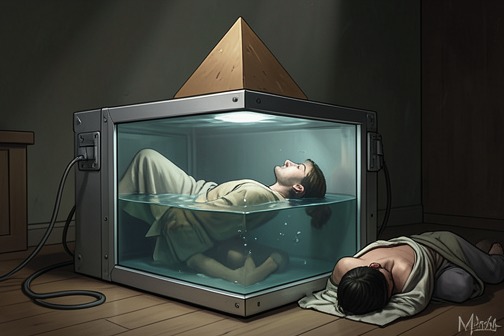
[Langdon Is Rescued from the Breathable-Liquid Chamber](entity:event-recall-event-e0c250c56ca4) is the apparent death and unexpected revival of [Robert Langdon](entity:character-recall-character-robert-langdon-40771bb1ed5b). Trapped in a sealed tank while [Mal’akh](entity:character-recall-character-mal-akh-bd4f697ab5c9) presses him for the solution to the [Masonic Pyramid](entity:object-recall-object-masonic-pyramid-8b8bdfea92d8), Langdon faces the end of his life just as he finally understands the capstone’s message. He gives Mal’akh the key to the pyramid, loses consciousness beneath the liquid, and is found by [Inoue Sato](entity:character-recall-character-inoue-sato-6172b90919ce)’s team. What first seems an irreversible death becomes a disorienting passage back to life, enabled by the same technology that made the chamber a tool of terror.
## The Chamber and the Threat
Mal’akh holds Langdon inside a heavy, locked container in a basement room, with [Katherine Solomon](entity:character-recall-character-katherine-solomon-3fe9f5b28ace) bound nearby and unable to intervene. The pipes running into the container make the threat appear straightforward: air enters first, then liquid follows. Langdon discovers a small vent and realizes that air is being pumped in, but the sound of liquid moving through the plumbing transforms that temporary relief into another danger. The arrangement gives Mal’akh control over both the apparent timing of Langdon’s death and the information he wants from him.
The ordeal also draws Katherine into the confrontation. Mal’akh makes her watch and invokes the drowning of her assistant, [Trish Dunne](entity:character-recall-character-trish-dunne-e4e80d90b790), as well as the earlier night at the Solomon family estate when [Peter Solomon](entity:character-recall-character-peter-solomon-26362346e09e) shot him and he fell through the ice near Zach’s bridge. He presents his survival of that attack as evidence that the gods protected him and directed his transformation. The references connect the present threat to the family’s earlier violence and show that Mal’akh sees his survival not as chance but as part of a larger destiny.
The tank’s operation depends on a concealed difference between its appearance and its contents. Langdon believes he is being submerged in water, while the device is supplied with breathable liquid. That distinction does not make the experience safe: the chamber is designed to induce the fear and disorientation of drowning, and Mal’akh uses that fear to force a response. Katherine’s presence adds a second stake. Langdon is not only trying to stay alive; he is conscious that his friend is being made to witness what appears to be his death.
## The Cipher Revealed Under Pressure
As the liquid rises, Langdon’s attention returns to Katherine’s interrupted explanation of the capstone. Her words about the secret hiding within prompt him to reconsider a principle he recognizes from the Ancient Mysteries: the search for divinity turns inward rather than toward the heavens. In this moment of extreme confinement, an abstract maxim becomes a practical clue. The message is not a separate instruction placed plainly on the capstone; its meaning is concealed within the arrangement of the text itself.
Langdon understands that the capstone’s inscription is a symbolon, a message assembled from parts, and that it tells him how to decipher the grid of symbols on the pyramid’s base. Its simplicity is the point: the message has been visible throughout the night, but its segmented form has disguised the relationship between clue and cipher. The golden capstone, which Peter Solomon had described as a talisman capable of bringing order from chaos, proves to be both an object in the puzzle and a guide to solving it.
With almost no air space left, Langdon signals that he has solved the cipher and communicates the method through the tank’s viewing window. Mal’akh demands the answer, and Langdon gives him the information rather than allowing the solution to die with him. The exchange reverses their positions briefly: Mal’akh has physical control of the chamber, but Langdon possesses the knowledge he needs. Once the answer is delivered, however, Mal’akh offers no rescue. He treats the solution as a completed transaction and leaves Langdon submerged.
## Apparent Death and Discovery
The narrative carries the threat to its apparent conclusion. Langdon’s body gives way to the involuntary need to breathe, and Katherine witnesses his loss of consciousness. The text presents him as dead; Mal’akh closes the tank’s viewing window and takes Katherine from the room. For her, the scene has ended in bereavement, and for Langdon the surrounding world has disappeared into sensory darkness. The book’s later reversal depends on letting this apparent ending stand long enough to change the meaning of what follows.
An explosion and the arrival of Inoue Sato’s agents interrupt Mal’akh’s control of the basement. Katherine, barely able to respond, tells her rescuers that the attacker went to the sacred mountain. Sato descends into the hidden rooms and recognizes Langdon’s clothing on the floor beside the large container. When she opens its small window, she sees Langdon beneath the liquid and understands that the tank, not an ordinary water-filled box, is central to what has happened. The physical evidence of his apparent death becomes the beginning of his recovery.
## Liquid Ventilation and Revival
Sato identifies the liquid as an oxygenated perfluorocarbon used in Total Liquid Ventilation. The underlying research has medical and military applications: the technology grew out of attempts to help premature babies breathe and was also developed for uses in which breathing liquid could offer advantages over gas. In this chamber, however, lockable latches and the surrounding setup suggest a coercive use. The breathable liquid permits a person to remain submerged, while sensory deprivation and the expectation of drowning can overwhelm the person’s ability to distinguish survival from death.
Sato chooses not to wait for a medical team before attempting to reach Langdon. She orders the lights turned off and blankets brought in, then the agents remove him from the tank and work to restore his breathing. His return is not immediate or serene. He experiences the extraction as a violent rupture from a dark, disembodied state: he is pulled into a world of noise, pressure, blurred vision, and cold air. The sequence echoes birth without making the transition gentle; recovery itself is painful and disorienting.
Wrapped in towels and blankets on the floor, Langdon gradually recognizes a familiar face and begins to understand what has happened. His survival alters the consequences of the ordeal without undoing it. Mal’akh has obtained the method for decoding the pyramid, Katherine has watched the man she trusts appear to die, and Langdon must recover from an experience engineered to erase his sense of whether he is alive. The chamber is therefore both an instrument of coercion and the means by which he returns: the same breathable liquid that sustains his body makes his apparent death convincing, while Sato’s intervention turns that false ending into a narrow escape.
Event 30
Katherine’s Weighing Experiment on the Dying
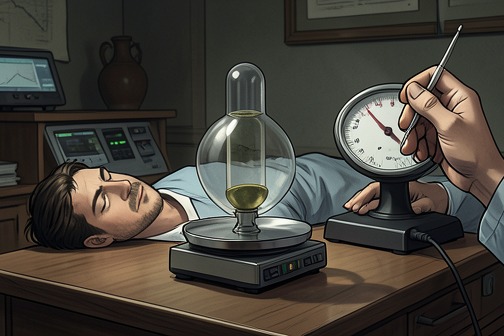
[Katherine’s Weighing Experiment on the Dying](entity:event-recall-event-b6c870140091) is the culmination of [Katherine Solomon](entity:character-recall-character-katherine-solomon-3fe9f5b28ace)’s attempt to test whether consciousness, or what traditions call the soul, might have a measurable physical correlate. Using an airtight capsule and a precision scale, she weighs a dying man before and after his death. The change she records is small but measurable, giving [Peter Solomon](entity:character-recall-character-peter-solomon-26362346e09e) a startling reason to consider that something may leave the body at death.
## Question and Design
Katherine’s idea grew out of a conversation with her brother about whether a human soul could survive apart from the body. She had long regarded life after death as a comforting human invention, and her scientific studies had displaced her earlier ideas of heaven, hell, and an afterlife. Yet the discussion led her to reconsider the question in experimental terms. Ancient accounts described the soul as something distinct from the body; Genesis, as Peter recalled it to her, used the word Neshemah for a spiritual intelligence. Katherine reasoned that if thought had mass, perhaps the soul might have mass as well. The possibility struck her as nearly impossible, but she could not dismiss it.
Three days after the conversation, Katherine woke with a plan and went straight to her laboratory. She spent four months designing and building a device before showing it to Peter, deliberately keeping the work from him until it was ready. The machine resembled an adult-sized transparent sleeping pod, but it was also a high-precision microbalance. Its initial digital reading was zero; when Katherine placed a tiny scrap of paper on the capsule, the scale registered 0.0008194325 kilograms. The reading demonstrated the instrument’s sensitivity, a few micrograms, before she explained that its subject would be a person.
The experiment depended on isolating that person from the environment. Once sealed, the capsule admitted or released no gas, liquid, dust, breath, sweat, or other material. Katherine acknowledged that the person inside would soon die, estimating that the available air would last about six minutes, depending on breathing rate. The controlled enclosure was central to the test: if the measured weight changed at death, she wanted to rule out ordinary matter escaping from the body as the explanation.
## The Recorded Test
Rather than describe the design alone, Katherine showed Peter a video of the experiment. The subject was a very ill former science teacher of hers from [Yale University](entity:organization-recall-organization-c7e83f9fc73d). He had maintained contact with her and, after Katherine explained the idea, agreed to take part, having already said that he wanted to donate his body to science. His wife and a hospice worker were present in the bedroom where the test was conducted.
The footage showed the capsule beside the bed, with the teacher lying inside and an oxygen mask on his face. When the hospice worker judged that he was ready, she removed the mask and moved the respirator and other equipment aside. The man’s wife leaned over to kiss his forehead; he did not open his eyes, but his lips formed a faint smile. She then lowered the transparent lid and sealed the capsule, as Katherine had taught her. The sequence makes the experiment a shared undertaking: the dying man had consented, and his wife and the hospice worker remained with him as the test proceeded.
The scale displayed a body weight of 51.4534644 kilograms. Peter watched as the man’s breathing became shallower and faster, then stopped. For a few seconds, the reading did not change. Katherine waited, directing Peter’s attention back to the display rather than announcing a result in advance. Moments after the man died, the number fell. The decrease was minuscule, but the instrument registered it. Nothing in the footage showed a larger change or established what had caused the difference; the experiment’s force within the story comes from the measurable result and the question it raises.
## Interpretation and Consequences
Katherine’s lab notes treated the observation cautiously. She wrote that an invisible material appeared to exit the body at death, possessed quantifiable mass, and was not impeded by physical barriers; she assumed it might move in a dimension she could not yet perceive. The notes record a hypothesis prompted by the measurement, not a demonstration that the departing material was definitively a soul. Peter supplied the striking interpretation: he thought Katherine might have weighed the human soul. The distinction matters. The scale gives them an observable change, while its meaning remains an inference.
For Katherine, the result opened a route from an abstract philosophical dispute toward questions she had considered beyond scientific proof. If something like a soul or consciousness could move outside the body, the observation might bear on ideas including transmigration, cosmic consciousness, near-death experiences, astral projection, remote viewing, and lucid dreaming. These are implications she sees as newly illuminated, not separate phenomena proved by the test. Her earlier skepticism therefore gives way not to a settled doctrine but to the possibility that a familiar boundary between body and consciousness may be less secure than she had believed.
Peter responds with silence and tears. Katherine understands his reaction in light of their losses, especially his continuing guilt about [Zachary Solomon](entity:character-recall-character-zachary-solomon-d8ec2ec2095c). Peter had told her that leaving his son in prison was the worst mistake of his life and one he could not forgive himself for. The experiment’s possible suggestion of continued existence carries, for him, a personal hope as well as a philosophical implication. Its result does not undo that history or establish what happens after death; it changes the emotional conditions under which the question can be asked.
## Recollection and Narrative Role
The experiment reaches the reader as Katherine remembers it while lying in a basement room. The recollection gives a full account of her method and the result, then breaks when a door slams and the tattooed man returns. Katherine hears him moving through the rooms and sees him push a wheelchair into the light. The person in it is Peter, alive, but altered: his head has been shaved, he wears a black silk gown, and his right hand is gone. The shift from the recorded death of Katherine’s teacher to the sight of her brother alive makes the memory an abrupt encounter between mortality as a scientific question and the immediate fact of Peter’s survival.
The episode also places a measuring instrument at the border between what can be observed and what remains uncertain. Katherine can design an airtight system, record a precise weight, and identify a change after death; she cannot make the measurement alone answer what departed or where it went. That gap is not a flaw the narrative closes. It is the experiment’s decisive significance: a controlled result unsettles Katherine’s former certainty, gives Peter a reason for hope, and leaves the larger mystery open.
Event 31
Peter Abandons the Attempt to Rescue Zachary, Who Dies in Prison
[Peter Abandons the Attempt to Rescue Zachary, Who Dies in Prison](entity:event-recall-event-1af7a2409cfa) is the remembered turning point in which [Peter Solomon](entity:character-recall-character-peter-solomon-26362346e09e) declines an opportunity to secure his son’s release from [Soganlik Prison](entity:organization-recall-organization-soganlik-prison-27a9351bc75f). The choice ends in [Zachary Solomon](entity:character-recall-character-zachary-solomon-d8ec2ec2095c)’s death and, in [Mal’akh](entity:character-recall-character-mal-akh-bd4f697ab5c9)’s account, marks the birth of the identity that will later make Peter’s past a weapon against him.
## The Choice and Its Consequence
Peter had earlier confronted Zachary with a choice between wealth and wisdom; Zachary chose poorly. Later, while Zachary was imprisoned in Soganlik Prison, the warden offered to let him go. Peter chose not to accept the offer, deciding instead to teach his son a lesson. The account does not supply the terms of the offer or the details of Peter’s reasoning beyond that stated purpose.
The consequence was irreversible: Zachary died in the prison. As Mal’akh recalls it, the world knew the story of Zachary’s death but did not know that Peter could have saved him. The event therefore turns on a concealed possibility: Zachary’s fate was not presented as unavoidable, but as the outcome of a choice made by his father.
## Mal’akh’s Memory of the Night
The episode is presented through Mal’akh’s recollection. He says he was there and heard the exchange, and that he never forgot the night Peter chose to abandon Zachary. The memory carries an intimate force because Mal’akh does not describe the decision as distant family history: he treats it as the moment Zachary’s life ended and his own new identity began.
That framing makes the prison decision more than a past tragedy in the Solomon family. It becomes part of the origin story Mal’akh uses to understand himself and his relation to Peter. The passage does not elaborate on what Mal’akh witnessed beyond the warden’s offer and Peter’s choice, but it establishes that he was present and that the scene remained central to his memory.
## The Past Used as a Weapon
Mal’akh later repeats the story to Peter while Peter is restrained and [Katherine Solomon](entity:character-recall-character-katherine-solomon-3fe9f5b28ace) is bleeding beside him. Mal’akh threatens that Katherine will die unless Peter cooperates, then invokes the earlier abandonment: Peter, he says, had already chosen to leave a family member behind when Zachary was in Soganlik Prison. Katherine hears the accusation and protests, while Peter struggles against his restraints.
The parallel is deliberate. Mal’akh places Peter before another choice involving a loved one’s survival and uses the prison episode to intensify the threat. The remembered decision thus returns as an instrument of coercion: the possibility that Peter once could have saved Zachary becomes the pressure point through which Mal’akh tries to control his response to Katherine’s danger. In the event’s wider significance, the death in prison is both the consequence of Peter’s earlier decision and the grievance Mal’akh carries into his later assault on the family.
Event 32
Mal’akh Takes Peter Hostage to the House of the Temple
[Mal’akh Takes Peter Hostage to the House of the Temple](entity:event-recall-event-537fd784015e) is the episode in which [Mal’akh](entity:character-recall-character-mal-akh-bd4f697ab5c9) removes the captive [Peter Solomon](entity:character-recall-character-peter-solomon-26362346e09e) from [Katherine Solomon](entity:character-recall-character-katherine-solomon-3fe9f5b28ace) and transports him to the [House of the Temple](entity:location-recall-location-house-of-the-temple-c11c5a6b7f69). The journey makes Peter’s family ties part of Mal’akh’s leverage: Katherine is left in mortal danger while Peter is forced to assist in the search for the Lost Word. At its destination, the pursuit circles back to the Temple Room where Peter’s Masonic brethren once initiated Mal’akh, setting the antagonist’s intended transformation against the coercion and captivity through which he seeks it.
## Background and Stakes
Before the journey begins, Katherine is lying in a basement after Mal’akh has used a medical needle to make her lose blood. Peter, shaved and dressed in a black silk gown, is bound and gagged in a wheelchair; his right hand is gone, and a fresh bandage covers the stump. Seeing her brother alive brings Katherine relief, but his condition and restraint immediately make the reunion frightening. Mal’akh tells her that Peter has a role to play and says he intends to take him to a sacred mountain, where the treasure’s location has been revealed by the [Masonic Pyramid](entity:object-recall-object-masonic-pyramid-8b8bdfea92d8). He names [Robert Langdon](entity:character-recall-character-robert-langdon-40771bb1ed5b) as someone whose help made the discovery possible.
Mal’akh uses Katherine’s condition to compel Peter’s cooperation. He tells Peter that Katherine may survive if Peter complies quickly, making her remaining time the measure of his own choices. The threat also turns the earlier tragedy of Peter’s son, [Zachary Solomon](entity:character-recall-character-zachary-solomon-d8ec2ec2095c), into a weapon. Mal’akh taunts Peter with his decision not to secure Zachary’s release from [Soganlik Prison](entity:organization-recall-organization-soganlik-prison-27a9351bc75f) when a warden offered it, and describes that past loss as a gain for himself. The scene thus binds the immediate hostage-taking to Peter’s older guilt: Mal’akh does not merely need Peter’s knowledge; he uses Peter’s history with his family to intensify the pressure.
## The Forced Departure
As Mal’akh prepares to leave, he packs ceremonial supplies, including incense, vials of liquid, white satin cloths, and the [Akedah Knife](entity:object-recall-object-18b52d37df0d). He also places Robert Langdon’s leather bag, containing the Masonic Pyramid and its capstone, with the equipment. He then sets the heavy bag on Peter’s lap. Peter’s resistance is visible in his attempts to struggle from the wheelchair, but his restraints and gag prevent him from stopping the departure or speaking freely to Katherine.
Before taking Peter away, Mal’akh inserts a needle into Katherine’s vein and leaves her losing blood on the stone table. He presents this as a deadline, telling Peter that she may live for about an hour and that his cooperation could give Mal’akh time to save her. He then gags Katherine and backs Peter’s wheelchair out of the room. The siblings exchange a final look before Mal’akh takes Peter up the ramp and through the metal door. He locks it behind them, leaving Katherine alone in the dark. The departure turns a brief family reunion into a separation under threat: Peter is carried away with the means to continue the search, while Katherine is left behind with no immediate help.
## Entry to the House of the Temple
Less than ten miles away, Mal’akh wheels Peter across a parking lot toward a large, deserted building. Its thirty-three exterior columns, each thirty-three feet tall, connect the setting to the sacred number that recurs in the Masonic world of the novel. Mal’akh appears from a distance to be a tall, kindly-looking man taking an invalid for a walk, a calm exterior that conceals the coercion of the journey. At the rear entrance, Peter refuses to enter the security code. Mal’akh supplies it himself, using the access code he received after his initiation into the thirty-third degree.
That access is significant because Mal’akh is not approaching the building as an outsider forced to break in. His initiation has given him a way through its security, while Peter’s membership and authority make him useful once they are inside. Mal’akh again invokes Katherine to press Peter to cooperate, then wheels him through the building to an elevator. He selects the uppermost button where Peter can see him do so. The route makes Peter’s captivity an instrument for reaching the building’s inner spaces, and the threat to Katherine remains active as they ascend.
## Return to the Temple Room
Mal’akh’s purpose is to find what the Masonic Pyramid’s message has led him to seek. By rearranging the pyramid’s symbols with [Franklin’s Order-Eight Magic Square](entity:object-recall-object-1efbe23b25a3), he has read the clue as pointing beneath the House of the Temple, also known among its brethren as Heredom. The building’s steep, pyramid-like roof reflects its name, which derives from a legendary Scottish mountain. Mal’akh believes the Lost Word is hidden somewhere beneath it and expects Peter, the Worshipful Master, to help him interpret what remains of the cipher.
When the elevator opens on the third floor, Mal’akh sees the Temple Room: a great square chamber with Masonic symbols and an oculus above. It is the same room where Peter and his brethren initiated him. The return gives the hostage-taking its defining reversal. Peter is brought back to the institution to which he belongs, but not as a brother acting freely; he is a gagged captive whose knowledge Mal’akh intends to exploit. Mal’akh regards the return as the completion of years of planning and anticipation, while the room’s association with his initiation exposes the conflict between the identity he received there and the transformation he now seeks through the Lost Word. The event ends with Mal’akh and Peter inside the Temple Room, at the threshold of the search that Mal’akh believes will disclose the secret beneath the House of the Temple.
Event 33
Blackmail with a Masonic Ritual Video and Its Foiled Leak
[Blackmail with a Masonic Ritual Video and Its Foiled Leak](entity:event-recall-event-ac6dbba6bd16) is [Mal’akh](entity:character-recall-character-mal-akh-bd4f697ab5c9)’s attempt to turn a private initiation ceremony into leverage over [Peter Solomon](entity:character-recall-character-peter-solomon-26362346e09e) and a public threat to [Freemasonry](entity:organization-recall-organization-freemasonry-9faba02911a5). The recording shows Peter leading Masonic rites and reveals influential attendees, including the director of the [Central Intelligence Agency](entity:organization-recall-organization-f8fce2cfb9d5). By threatening to send the footage to major media outlets unless Peter helps him locate the Lost Word, Mal’akh makes the secrecy surrounding the ceremony a weapon. The file transfer advances nearly to completion, but a targeted electromagnetic pulse disables its likely relay node, and officials later find no evidence that the video reached the public.
## Discovery and the Video’s Contents
[Robert Langdon](entity:character-recall-character-robert-langdon-40771bb1ed5b) first learns the extent of the crisis aboard a Central Intelligence Agency helicopter bound for the [House of the Temple](entity:location-recall-location-house-of-the-temple-c11c5a6b7f69). In a blond hairpiece found at Mal’akh’s home, investigators had discovered a tiny fiber-optic camera concealed in the bangs. [Inoue Sato](entity:character-recall-character-inoue-sato-6172b90919ce) shows Langdon its recording on a computer in a titanium briefcase. The footage begins with Mal’akh, disguised with a wig and bronzing makeup, recording his reflection while dressed as an initiate preparing to enter Freemasonry’s first degree.
The video then moves through ceremonies at [Potomac Lodge No. 5](entity:location-recall-location-potomac-lodge-no-5-99411386abe5), where Peter Solomon presides. Langdon recognizes the lodge by the powder-blue triangular pediment above the master’s chair. The footage presents elements from several stages of initiation, including ritual dress, symbolic tests, warnings about secrecy, and a staged death in the third degree. Later, it shifts to the House of the Temple and shows a gathering in the Temple Room. The recording’s sweep across the assembled members reveals two Supreme Court justices, the secretary of defense, the speaker of the House, several senators, the secretary of homeland security, and Sato.
At the ceremony’s climax, Peter offers the initiate wine in a human skull as part of the oath-taking ritual. Langdon recognizes the rite from historical accounts, but seeing it recorded gives the ceremony a different force: private symbolic practices are now available as moving images, detached from the explanations that would place them in context. The video ends with Peter welcoming Mal’akh into the brotherhood.
## A Private Ritual Reframed as Public Scandal
The recording’s danger lies not only in what it shows, but in how it has been assembled. Langdon recognizes that its editing selects the most alarming moments and omits what he regards as the initiation’s nobler purpose. In his understanding, Masonic ritual uses symbolic encounters with death to make initiates reflect on the limits of life and the importance of honor, integrity, and service. The video instead presents a sequence that can be read as evidence of a secretive and threatening organization.
That framing turns the exposure into more than a reputational embarrassment for individual Masons. The footage places recognizable public officials inside a closed ceremony and invites viewers to interpret their participation without the context available to members. Langdon fears that its circulation could fuel anti-Masonic hostility and conspiracy claims, while the government’s presence among those recorded could make the consequences national in scale. His alarm also echoes his earlier explanation to students that Freemasonry is a society with secrets rather than a secret society: the distinction depends on limits to access, trust built through membership, and obligations to keep certain knowledge private. Once the ceremony is detached from those boundaries, outsiders can impose their own interpretation.
## Mal’akh’s Threat and Peter’s Position
Mal’akh uses the video against Peter while Peter is captive. He points to a cellular modem connected to his laptop and threatens to share the recording unless Peter helps him discover where the Lost Word is hidden. He also presents the release as a way to harm Peter’s Masonic brethren, extending the pressure beyond Peter’s immediate predicament. The demand links two kinds of secrecy: the ritual knowledge exposed by the recording and the location Mal’akh hopes to extract from the pyramid’s final code.
To make the threat immediate, Mal’akh opens an email prepared for a list of major media networks and starts sending the video. Peter sees the transfer progress on the laptop while Mal’akh places the symbol grid before him and insists that it contains the answer. The episode therefore gives the recording a double function: it is both a prospective public disclosure and an instrument for coercing information from Peter. The threat is credible because it has moved beyond a private promise; the file is already in the process of leaving Mal’akh’s computer.
## Interception and Aftermath
At the Central Intelligence Agency, [Nola Kaye](entity:character-recall-character-nola-kaye-fa66c9a28c82) explains that shutting down ordinary internet service would not reliably stop the transfer, since the laptop could use a wireless provider. She proposes targeting the source of the connection instead. Investigators searching Mal’akh’s home find packaging for a recently purchased cellular modem. Using its model number, Kaye narrows down compatible carriers and service grids and identifies a likely access point: a small transmitter near Sixteenth and Corcoran, three blocks from the House of the Temple.
As the helicopter approaches, its pilot makes a low-altitude pass and directs an electromagnetic pulse at the relay node. The pulse knocks the transmitter offline only seconds before the laptop’s transfer is complete. Later, Sato receives Kaye’s report that there are still no signs of distribution. Although the transmission had appeared to complete on the laptop, the crucial consequence is that officials find no evidence that the video was disseminated. The crisis ends without the threatened public release, while the recording’s existence has already exposed the vulnerability created by combining a concealed camera, a portable computer, and a cellular connection.
## Significance
The episode turns Freemasonry’s secrecy from an abstract subject of discussion into a practical conflict over who controls images, context, and access. Earlier, Langdon had described initiation as a process whose symbols acquire meaning within a community and through a sequence of degrees. Mal’akh’s recording collapses that sequence into selected scenes that can circulate without the community’s explanations. The attempted leak thus makes editing itself consequential: the same ritual can appear as moral instruction to its participants and as a threatening spectacle to an audience given only its most provocative images.
The failed release also sharpens the contrast between the brotherhood’s boundaries and the reach of modern communications. A private ceremony can be captured covertly, packaged for major media, and sent through a cellular network; stopping that passage requires locating and disabling the particular relay on which it depends. The interception prevents the threatened exposure from becoming public, but it does not undo the blackmail or erase what the recording reveals to those who have seen it.
Event 34
Zachary Solomon身份揭露
The revelation that [Mal’akh](entity:character-recall-character-mal-akh-bd4f697ab5c9) is [Zachary Solomon](entity:character-recall-character-zachary-solomon-d8ec2ec2095c) turns a night of ritual threats into a reckoning between a father and the son he believed dead. In the [House of the Temple](entity:location-recall-location-house-of-the-temple-c11c5a6b7f69), Mal’akh exposes the survival concealed behind Zachary’s reported death at [Soganlik Prison](entity:organization-recall-organization-soganlik-prison-27a9351bc75f) and makes [Peter Solomon](entity:character-recall-character-peter-solomon-26362346e09e) confront the consequences of their past. At the same time, [Katherine Solomon](entity:character-recall-character-katherine-solomon-3fe9f5b28ace) finds a photographic record that independently confirms the impossible truth: Zachary lived, changed his appearance and identity, and became the man pursuing the family.
## The Revelation in the Temple
The disclosure occurs as Mal’akh tries to make Peter take part in a ritual intended to complete Mal’akh’s transformation. Peter has been brought to the Temple Room, where the setting recalls the solemn Masonic ceremonies he knows, but Mal’akh’s purpose is not ordinary initiation. He insists that the decisive offering is to be himself, and presents Peter with a role in the transformation he believes will free him from his body. The difference between ritual symbolism and actual danger becomes central: Mal’akh treats the ceremony as a means to acquire power, while Peter is forced to face what the ritual demands of him.
Mal’akh then turns the confrontation from ritual to family history. He accuses Peter of having caused the family’s suffering by leaving Zachary in prison rather than paying to secure his release. Peter rejects the accusation as a distortion of his reasons, but Mal’akh insists that the choice was the beginning of the chain of events that followed. His charge is not simply that Peter failed to rescue him; it is that Peter made a consequential decision and then failed to recognize the son who returned. The revelation thus places Peter’s present captivity beside an older, unresolved paternal failure.
The identity claim lands with particular force because Mal’akh has spent years treating Zachary’s former identity as something he abandoned. He tells Peter that the decision to leave him in prison made him feel rejected, and that he ceased to regard himself as Peter’s son. Calling himself Peter’s returned son makes the revelation at once an exposure of fact and an accusation: Mal’akh wants recognition, but he presents it as the culmination of his grievance rather than a bid to repair their relationship.
## How Zachary Survived
Mal’akh explains that the death attributed to Zachary in prison was staged. The prison warden wanted a bribe; when Mal’akh offered to pay, the warden arranged for a sickly inmate of similar size to be dressed in Zachary’s clothes and killed. The photographs and sealed casket Peter had taken as proof of his son’s death therefore belonged to a stranger. The substitution explains how Zachary could have survived the event that ended, for Peter and the public, in a reported prison death.
The account also clarifies the steps between Zachary and Mal’akh. After leaving prison, Zachary changed his body using experimental growth hormones and steroids. His adolescent appearance and voice gave way to a more muscular build and a permanently altered voice; he first became Andros and then Mal’akh. Mal’akh describes this sequence as transformation, not as a return to his former self. By the time he reveals his identity, the change has been carried so far that Peter does not recognize his own son.
The revelation is supported by evidence discovered elsewhere during the same crisis. In Mal’akh’s home, Katherine finds newspaper clippings and photographs devoted to the Solomon family, including material about Peter, her own research, their mother Isabel, and Zachary’s drug use, imprisonment, and reported death. The collection initially suggests an obsessive interest in the family but does not explain its source. A photograph of Zachary on a beach is dated nearly a year after the prison death. Katherine then sees further images that trace his aging and bodily changes, including the emergence of tattoos. Her discovery gives the family’s history a visible record that corroborates Mal’akh’s disclosure to Peter.
## Foreshadowing and Recognition
The book has already connected Mal’akh to Masonic ritual through a recording found by the [Central Intelligence Agency](entity:organization-recall-organization-f8fce2cfb9d5). A small camera hidden in a blond hairpiece records an initiate preparing for the first degree of [Freemasonry](entity:organization-recall-organization-freemasonry-9faba02911a5); [Robert Langdon](entity:character-recall-character-robert-langdon-40771bb1ed5b) recognizes the man as Mal’akh. The footage then shows a lodge ceremony led by Peter, establishing that Mal’akh had entered the ritual world associated with Peter before the final confrontation. The recording makes his use of disguise and his knowledge of Masonic practice part of a larger plan, rather than an incidental feature of his appearance.
That earlier footage also gives a different weight to Peter’s role in the revelation. Peter appears in the recording as the master conducting an initiation, while, in the Temple Room, he is a captive confronted by a son who has remade himself around rejection and secrecy. The ceremony’s rules and symbols offer Mal’akh a language for his intended transformation, but they cannot conceal the family history that he finally names. His identity is disclosed not through an institutional investigation alone, but through a direct confrontation in which Peter is required to recognize the person behind the altered appearance.
## Katherine’s Parallel Discovery and the Event’s Consequences
Katherine’s discovery unfolds separately from Peter’s encounter, and its timing turns the revelation into more than Mal’akh’s unsupported claim. She first finds a file of material about the family, then notices that the dates on the photographs contradict the accepted account of Zachary’s death. As the sequence progresses, the images show not a single unexplained appearance but a gradual transformation. The evidence changes her understanding of the man’s fixation: the person who has targeted the Solomons is not merely an outsider obsessed with them but a family member whose history is bound to theirs.
The two strands expose different dimensions of the same secret. Peter hears the history as an indictment of his decision and as proof that his son survived. Katherine reads it in the accumulating photographs, where altered dates and changing features overturn the public story of Zachary’s death. Together, the scenes make recognition painful and incomplete: Peter learns who Mal’akh is, but the revelation does not undo the years of separation or the harm Mal’akh has caused. Instead, it clarifies the personal grievance beneath his actions and sharpens the stakes of the ritual he is trying to impose.
The disclosure also reframes the family’s apparent past. Zachary’s reported death had seemed to close the story of Peter’s son; the substitute prisoner and the later photographs reopen it, showing that the ending Peter believed in was false. Yet Zachary’s survival did not restore the former family relationship. Mal’akh presents his new identity as the result of his father’s decision and uses the truth to make Peter experience the cost of not recognizing him. The revelation therefore resolves one mystery while exposing a deeper rupture: the lost son has returned, but as an adversary who has made transformation inseparable from revenge.
Event 35
The Ritual Is Thwarted in the Temple Chamber and Mal’akh Dies
The ritual in the Temple Room of the [House of the Temple](entity:location-recall-location-house-of-the-temple-c11c5a6b7f69) is the climax of [Mal’akh](entity:character-recall-character-mal-akh-bd4f697ab5c9)’s effort to turn his own death into a passage to supernatural power. He prepares to offer his body as a sacrifice and coerces [Peter Solomon](entity:character-recall-character-peter-solomon-26362346e09e) into acting as the instrument of that offering. Peter raises the [Akedah Knife](entity:object-recall-object-18b52d37df0d), but does not kill him; instead, a helicopter’s arrival shatters the room’s skylight, and falling glass fatally wounds Mal’akh. The reversal is both practical and symbolic: the ceremony ends not in transcendence, but in the death of the man who believed he had mastered its meaning.
## The Ritual and Its Intended Sacrifice
Mal’akh begins the ceremony in the chamber at the top of the House of the Temple, before its great altar. He has prepared his body over years, treating it as an artifact marked by ritual and inscribed symbols. Now, with Peter captive and watching, Mal’akh uses a crow’s-feather nib and Peter’s blood to write the Lost Word within the circular design on his scalp. He regards this act as the final preparation for apotheosis: in his understanding, receiving the Word makes a person ready for extraordinary power. The ritual is therefore not simply an attempt to kill Peter or escape captivity. Mal’akh believes that his own body, deliberately offered, is the essential gift.
The sacred setting reinforces his certainty. Incense rises above the altar, and moonlight enters through the chamber’s opening overhead. Mal’akh interprets the smoke and light as a route for a soul to leave the body. He imagines the ceremony as a passage beyond ordinary human limits, while the physical room remains the site of Peter’s captivity and a real, imminent threat. That tension between an imagined spiritual ascent and the material danger in the chamber governs the scene: Mal’akh treats the symbols as guarantees, but his plan depends on Peter making a choice under pressure.
Mal’akh presents the Akedah Knife as an artifact made for human sacrifice. He connects it to the biblical account of Abraham and Isaac and to the place of the Akedah in [Freemasonry](entity:organization-recall-organization-freemasonry-9faba02911a5)’s ritual tradition. For him, the knife’s history is not merely a matter of provenance: he believes its intended use has been withheld, and that he can fulfill that purpose now. After cutting the ropes that bind Peter to his wheelchair, Mal’akh places the knife in Peter’s left hand. The arrangement is meant to make Peter both the agent of the sacrifice and its unwilling witness, while Mal’akh casts himself as the offering.
## Peter’s Impossible Choice
Mal’akh’s coercion draws on more than Peter’s physical captivity. He invokes the danger to Katherine and the threatened release of a file, presenting Peter’s compliance as the only way to protect his sister and his Masonic brotherhood. He also blames Peter for the past decision to leave Zachary in prison, turning their family history into another weapon. The accusation makes the ceremony an attempted punishment as well as a ritual: Mal’akh wants Peter to act while believing that every possible choice will bring further loss.
Peter knows the knife’s significance and understands that Mal’akh expects him to use it. He rises from his wheelchair, approaches the altar, and grips the weapon while Mal’akh lies down on the prepared shroud. From Mal’akh’s point of view, the scene appears to confirm the ceremony’s design: the son’s hand is to deliver the fatal blow, and the father is to release him from his body. Yet Peter’s presence at the altar does not amount to consent. His distress makes the decision visible as a conflict between the threats before him and his refusal to accept Mal’akh’s account of what sacrifice requires.
## The Interrupted Climax
[Robert Langdon](entity:character-recall-character-robert-langdon-40771bb1ed5b) and [Turner Simkins](entity:character-recall-character-turner-simkins-d9587a60d61a) reach the Temple Room’s doors after hearing Peter’s anguished cry. Langdon opens them and sees the black-robed figure at the altar, the blade raised over the person lying there. He rushes toward the scene, believing Peter is in danger. At that instant, the helicopter above the chamber sends its searchlight through the skylight. The transmitted file reaches completion, a separate consequence that Mal’akh’s threats had made part of Peter’s dilemma.
The helicopter’s attempt to hold position strains the glass roof. Its pilot tries to lift away, but a landing strut strikes the skylight, which breaks and sends shards into the chamber. The sudden arrival of the helicopter and the collapse of the roof interrupt the ceremony through physical forces Mal’akh has not incorporated into his design. He had interpreted the light above the altar as confirmation that his transformation was succeeding; the breaking glass turns that apparent sign of deliverance into the cause of his mortal injury.
Langdon collides with the black-robed figure and discovers that he has tackled Peter, not Mal’akh. Peter has not plunged the knife into the man on the altar. The Akedah Knife lies broken against the stone, and Peter has refused to spill Mal’akh’s blood despite the pressure and the threats against his family. The distinction is decisive: Mal’akh’s intended sacrifice depends on Peter’s action, but Peter does not complete the act. The ritual fails at the point where Mal’akh had made another person’s violence the instrument of his supposed self-transformation.
## Mal’akh’s Death and the Aftermath
Mal’akh is left on the altar, unable to see and in severe pain as the helicopter leaves. The chamber’s imagery has changed meaning: the light and open roof no longer promise the ascent he anticipated, and the shattered glass marks the failure of his plan. He had believed that writing the Lost Word on his body and surrendering his flesh would bring him a divine reception. Instead, his own body is fatally damaged, and he is alone on the altar. Katherine’s survival further contradicts his assumptions; after the crisis, Langdon reassures Peter that she is safe.
When Katherine enters the brightly lit Temple Room, she sees Mal’akh’s body on the altar and the opening in the ceiling. She finds Peter being tended to by a medic, his right arm in a sling and his hand absent. Their reunion shifts the scene from the spectacle Mal’akh designed to the bond he could not break. Katherine embraces her brother, acknowledges his injury, and tells him that what matters is that he is alive and that she is safe. Peter, who has been the family’s protective figure, trembles in her arms; she comforts him in turn. The aftermath thus locates the lasting consequence not in Mal’akh’s imagined apotheosis but in the survivors’ grief, relief, and renewed care for one another.
Event 36
Decoding the Masonic Pyramid’s Final Cipher and Finding the Washington Monument
The decoding of the [Masonic Pyramid](entity:object-recall-object-masonic-pyramid-8b8bdfea92d8)’s final cipher turns a seemingly allegorical diagram into directions to the [Washington Monument](entity:location-recall-location-134577ee6422), where [Robert Langdon](entity:character-recall-character-robert-langdon-40771bb1ed5b) recognizes its last message as [Laus Deo](entity:expression-recall-expression-laus-deo-a399143e922d). The discovery culminates a chain of clues built from Masonic symbols, cipher grids, and magic squares, and hinges on a change of perspective: what Langdon had read as metaphor can also be read as a map.
## Clues Assembled
The pyramid’s final solution rests on earlier puzzles rather than on an isolated act of recognition. A tattoo on [Peter Solomon](entity:character-recall-character-peter-solomon-26362346e09e)’s hand initially appears to combine unfamiliar characters and numbers. Langdon questions that mixed reading and turns the hand upside down; from the new orientation, he can read a Roman numeral and the letters SBB. The episode establishes a recurring method: the marks do not change, but their arrangement and the angle from which they are read do.
Another clue is the [Masonic cipher](entity:concept-recall-concept-masonic-cipher-5674d25956ca) engraved on the pyramid. [Warren Bellamy](entity:character-recall-character-warren-bellamy-981c3b4e368e) explains that the pyramid is a map and that its [Gold Capstone](entity:object-recall-object-1cf853b2080d) serves as the map’s legend, or key. Langdon applies a simple grid-based substitution: each cipher shape corresponds to a letter enclosed in a matching cell. The ease of the procedure is misleading. The first decoding does not immediately disclose a destination; it sets up the more elaborate reading that follows.
A magic square supplies the next part of the method. Langdon explains the four-by-four square in Albrecht Dürer’s [Melencolia I](entity:object-recall-object-i-cb895535c818), in which rows, columns, and diagonals share a sum of thirty-four and additional groups of four also add to that total. Its arrangement makes the letter grid on the pyramid legible as a puzzle whose solution depends on numerical organization, not just on recognizing individual symbols. Later, when [Mal’akh](entity:character-recall-character-mal-akh-bd4f697ab5c9) works out that the phrase Order Eight [Franklin Square](entity:location-recall-location-f31d186ea0d7) indicates an eight-by-eight magic square, he identifies the principle needed to reorder the pyramid’s sixty-four symbols. These successive stages make the final reading depend on both substitution and rearrangement.
## From Allegory to Map
After the pyramid and its capstone have been reunited, Solomon shows Langdon the completed object and a grid of symbols reorganized using [Franklin’s Order-Eight Magic Square](entity:object-recall-object-1efbe23b25a3). Langdon first reads the grid as an allegorical image of heaven and earth: Heredom at the top, the pyramid rising from earthly foundations, and the [Circumpunct](entity:concept-recall-concept-circumpunct-75ccb9fdcdf0) above it as a sign of unity. Beneath the pyramid, he sees the [Winding Staircase](entity:concept-recall-concept-winding-staircase-8ac366e238cf) as a traditional ascent from darkness toward light. This interpretation gathers the image’s religious, astrological, Masonic, and philosophical associations into a shared symbolic scheme.
Solomon proposes a different kind of reading. The grid, he says, is not only an allegory but a map that indicates where the Lost Word is buried. The decisive shift begins in its northeast corner. In Masonic practice, the northeast placement of a cornerstone is associated with the first light of morning; read as a map, however, the grid’s downward-pointing arrow gives a direction: south. Heredom, in this reading, is not a metaphor for heaven but a geographic point. Because the tradition places the Lost Word in [Washington, District of Columbia](entity:location-recall-location-2d4d72a34a07), the direction narrows the search.
Solomon also connects the diagram to a traditional description of a large engraved stone above the entrance to a staircase. He points Langdon to seven symbols in the grid as the inscription that identifies the place. Langdon remains unconvinced: the symbols do not look like a conventional map or a recognizable monument. Solomon’s response is to insist that the clue is already visible, but that it requires a different perspective. The puzzle’s central reversal is therefore interpretive as well as cryptographic: the same marks that support a symbolic reading can also provide practical directions.
## The Monument Revealed
Solomon takes Langdon through secured doors and asks him to wear a Masonic hoodwink so he will not know their destination. The passage leaves Langdon disoriented; once the blindfold is removed, he is still in darkness, and Solomon guides him to a railing before illuminating a deep, square spiral staircase. Langdon can see at least thirty landings descending below him, an apparent confirmation of the legend Solomon has described. The sequence initially encourages him to think that they have entered an underground chamber.
Instead, Solomon leads him to a small room and a glass viewing portal. When the darkness beyond the glass resolves, Langdon sees the illuminated dome of the [United States Capitol](entity:location-recall-location-c17aa0c7a286) far below. He understands that he has not descended beneath a monumental stone: he has ascended to the Washington Monument’s summit. The apparent underground approach and the staircase’s depth had misdirected his expectations; the room is a viewing chamber near the monument’s pinnacle, 555 feet above the ground.
The setting makes the map’s directions concrete. From the chamber, Langdon looks north toward the White House and traces Sixteenth Street toward the [House of the Temple](entity:location-recall-location-house-of-the-temple-c11c5a6b7f69), placing himself south of Heredom. He also sees the Lincoln Memorial to the west and the Jefferson Memorial to the south. The view connects the pyramid’s abstract directional clues to recognizable points across the city, validating Solomon’s claim that the grid can be followed as a map.
## Laus Deo and the Final Reading
At the monument’s apex, Langdon recalls that its capstone weighs 3,300 pounds and is topped by a small, polished aluminum tip. The tip bears the inscription Laus Deo, in letters only an inch tall. He then understands the seven symbols on the pyramid’s base as a transliteration of that Latin phrase: a stonemason’s square supplies L, the element gold supplies AU, Greek letters provide S and D, alchemical mercury provides E, and the Ouroboros supplies O. The final cipher is not a long sentence but a sequence of signs that must be recognized through their associations and combined into words.
Laus Deo means praise God, and its placement on the monument’s tiny summit gives the solution both a physical location and a final message. The inscription is publicly displayed yet difficult to notice, matching the puzzle’s repeated suggestion that a secret can remain in plain view until someone knows how to read it. The journey ends not with the discovery of a hidden chamber beneath Washington, but with Langdon recognizing that the monument itself—and the inscription at its peak—completes the Masonic Pyramid’s code.
Event 37
The Lost Word Is Revealed as a Buried Bible
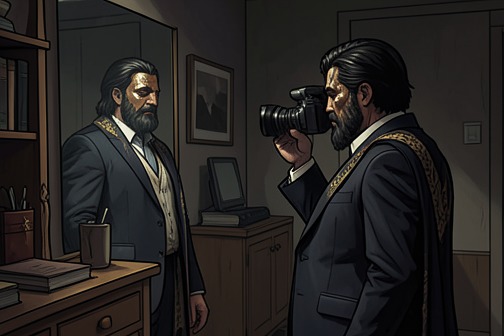
[The Lost Word Is Revealed as a Buried Bible](entity:event-recall-event-7167b6fb99c1) is the culmination of the pyramid’s trail: [Peter Solomon](entity:character-recall-character-peter-solomon-26362346e09e) identifies the Lost Word as a copy of the Bible buried inside the [Washington Monument](entity:location-recall-location-134577ee6422)’s cornerstone. But the revelation is not merely the discovery of a concealed object. Peter argues that the Word is the collected wisdom preserved in sacred texts, and that reading it requires recognizing the shared spiritual teaching he believes those texts contain. [Robert Langdon](entity:character-recall-character-robert-langdon-40771bb1ed5b)’s search therefore ends not with a supernatural portal, but with a challenge to reconsider what a book—and a word—can mean.
## From Cipher to Destination
The disclosure follows Langdon and Peter’s arrival at the top of the Washington Monument. The pyramid’s final code, [Laus Deo](entity:expression-recall-expression-laus-deo-a399143e922d), has led them to the obelisk, where Peter tells Langdon that the Lost Word is buried at the bottom of its winding staircase. The place turns the puzzle’s metaphorical language into a literal destination: a secret concealed beneath a national monument, reached by descending rather than ascending.
Peter gives Langdon the stone cube he had entrusted to him earlier and asks what its form suggests. Langdon recognizes a cornerstone, recalling the date [1514](entity:time-recall-time-1514-294496734605) engraved on the object. Peter explains the symbolic logic behind the resemblance. A cornerstone is buried beneath the ground as the building’s first step upward toward heavenly light; some cornerstones are also hollow vaults, made to hold objects intended as tokens of hope for the future. The box, with its cavity and stone form, has been pointing toward the kind of container—and the kind of burial—that could hold the answer.
Peter then makes the historical claim that resolves the search: the Lost Word was placed in the Washington Monument’s cornerstone on [July 4, 1848](entity:time-recall-time-july-4-1848-9d5d60a9beaa), in a Masonic ritual. Langdon is startled by the idea that the forebears of the Masonic tradition buried a word there. The monument’s height and the inaccessible position of its cornerstone sharpen the revelation: the Word is present, Peter insists, but not available for Langdon simply to retrieve and inspect.
## [The Word](entity:concept-recall-concept-the-word-c34ed5dd1f90) Is Not a Single Word
Langdon initially resists the idea that a lifetime of study could be reduced to one buried item. He thinks of the many texts and traditions through which the Ancient Mysteries might have been transmitted: the writings of Pythagoras, Hermes, Heraclitus, and Paracelsus; forgotten works on alchemy, mysticism, magic, and philosophy; and the libraries and inscriptions of earlier civilizations. His objection is not that the search has no intellectual value, but that its answer cannot plausibly be confined to one word in one place.
Peter answers by changing the meaning of the term. [The Lost Word](entity:expression-recall-expression-the-lost-word-03b97d5ca5d0) is not a single lexical solution, he explains; Word is what the ancients called a body of wisdom. The revelation thus shifts the puzzle from the material location of the secret to its interpretation. A buried Bible is the concrete object at the end of the trail, but the Word it embodies is larger than that copy: a record of spiritual teaching preserved in books.
A brief interlude with [Dean Galloway](entity:character-recall-character-dean-galloway-e6b8bf137cb9) extends this idea beyond Peter’s conversation. Praying for the country at the National Cathedral, Galloway describes the Word as the recorded wisdom of ancient teachers, carried through history in books. Different traditions have their own sacred volume, he reflects, yet each can serve as a vessel for enduring spiritual truths. The narrative places this meditation beside the monument revelation, widening the meaning of the buried Bible from a Masonic secret to a question about how sacred writing survives and is read.
## The Bible and the Ancient Mysteries
As Peter and Langdon descend the monument’s 896 stone steps, a carved medallion gives the interpretation a visual counterpart: a cloaked figure with a scythe and an hourglass points toward an open Bible. Peter takes the image as an instruction to look inside the book. He argues that the Bible’s parables, riddles, and dark sayings contain layers of meaning, and points to passages that describe wisdom as hidden or conveyed through parable. In his account, the surface reading is not the whole message; deeper understanding is reserved for readers capable of recognizing it.
Peter invokes the long history of scholars who pursued such readings. [Isaac Newton](entity:character-recall-character-isaac-newton-2ca72f7d43ae) devoted extensive writing to biblical interpretation, including a manuscript that claimed to extract scientific information from Scripture. Francis Bacon used codes and wrote about the wisdom of the ancients. Peter also recalls American founders who warned against taking the Bible literally, and Thomas Jefferson’s effort to revise the text by removing what he regarded as artificial additions. These examples support Peter’s case that the Bible has repeatedly invited interpretation beyond its surface narratives; they do not, by themselves, prove that a concealed message exists.
The argument reaches its central paradox when Langdon says that the Ancient Mysteries and the Bible seem opposed: the former concerns divinity within the human being, while the latter is commonly understood as placing God above humanity. Peter treats this division as the very misunderstanding that caused the Word to be lost. He claims that the Bible is one of the books through which the Mysteries have been transmitted, and that its obscured language carries the same wisdom found in other enduring texts. The novel presents this as Peter’s interpretation, not as a conclusion Langdon has already accepted.
## Meaning, Skepticism, and Consequence
Peter’s account gathers earlier motifs into a single explanation. In the Capitol, Langdon had described the Ancient Mysteries as a body of secret knowledge that traditions concealed in allegory and symbols, while remaining skeptical that such knowledge could grant extraordinary human powers. He had also insisted that portals and doorways generally signify transformative passage rather than physical entrances. The literal-minded search for a portal, in his view, confuses metaphor with reality. Now Peter reverses the emphasis: the ancient wisdom is real as a tradition of teaching, but its power lies in what readers learn from the texts, not in finding a magical doorway.
That distinction connects the final disclosure to the earlier [Chamber of Reflection](entity:concept-recall-concept-chamber-of-reflection-d6fba3c5a858). There, the inscription [VITRIOL](entity:rule-recall-rule-vitriol-ac90df0f5c30)—an acronym for an injunction to visit the earth’s interior and find the hidden stone—had offered several competing interpretations of what the stone might be: a pyramid, an alchemical Philosopher’s Stone, a sacred inner chamber, or hidden teaching. The Bible revelation does not erase that ambiguity so much as redirect it. The hidden treasure is both materially placed in a cornerstone and conceptually concealed within texts that must be interpreted.
Peter’s thesis also gives the Lost Word a plural and cross-cultural reach. He names the Bible, the Bhagavad Gita, and the Koran among the enduring texts that, in his view, preserve a shared message. He connects that message to the idea that human beings have forgotten their own divine potential, recalling the counsel to know oneself and the possibility that spiritual wisdom may be found within rather than imposed from above. The culmination therefore reframes the mystery: the book buried beneath the monument is a specific Bible, but the Word is not confined to one copy, language, or tradition.
For Langdon, the event resolves the physical riddle while leaving the intellectual one open. Peter has identified where the Bible lies and why its hiding place resembles a cornerstone vault, but Langdon remains skeptical that a single object can unlock the Ancient Mysteries. The scene’s decisive change is that he can no longer treat the Lost Word simply as a cipher to decode or a portal to locate. It is presented as an invitation to read enduring texts for wisdom that may be obscured in plain sight.